
Quantum-Enhanced Molecular Docking: Potential, Methods, and Current Limitations
In drug discovery, molecular docking helps researchers estimate how a small molecule might fit into a protein and which candidates merit closer study. Quantum-enhanced molecular docking explores whether quantum computing can improve parts of that calculation, especially the difficult task of modeling molecular energies. The approach is promising as a research direction, but it remains experimental: classical docking is still the practical foundation for most screening workflows.
What molecular docking does in drug discovery
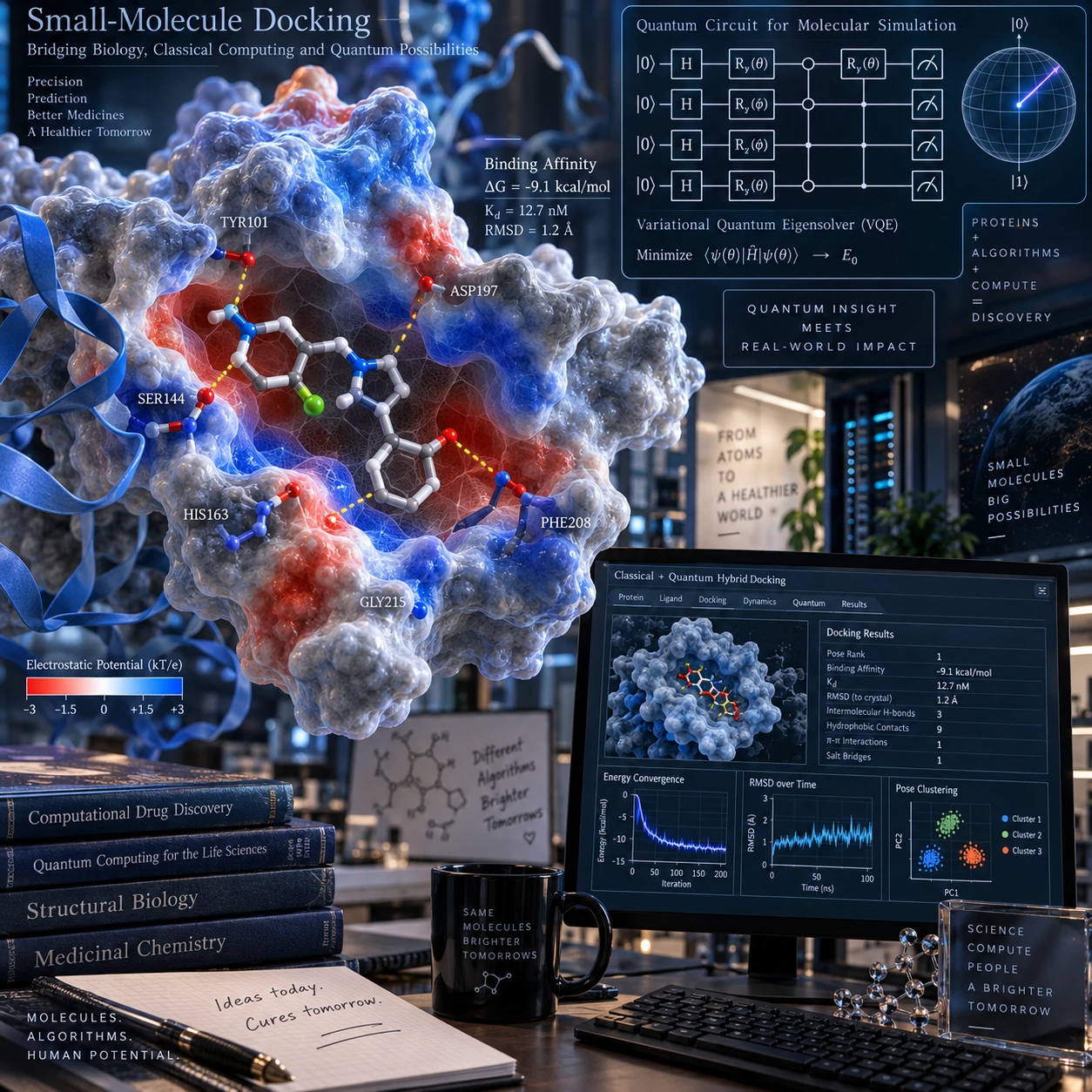
Molecular docking predicts plausible poses for a candidate molecule in a protein binding site and estimates how favorable those interactions may be. Drug-discovery teams use it to prioritize compounds for further testing, not to prove that a molecule will bind or become a medicine.
A docking program typically searches many possible ligand positions, orientations, and conformations inside a target protein’s binding pocket. It then scores candidate poses using approximations of effects such as shape complementarity, electrostatics, hydrogen bonding, and hydrophobic contacts. The output is a ranked set of predicted poses and scores, including an estimated binding affinity or a related score.
Those scores are useful for triage, but they are not direct measurements of binding strength. A high-ranking pose can still fail in biochemical assays because the scoring function simplifies solvent, protein flexibility, entropy, and other influences. Researchers therefore combine docking with structural biology, medicinal chemistry judgment, molecular dynamics, and experimental validation.
In a typical early-stage workflow, a team prepares a protein structure and a library of compounds, runs classical docking, inspects top poses, and selects a manageable group for follow-up. Docking can narrow a search, but it cannot replace assays that test whether a compound binds, changes protein activity, or behaves safely in biological systems.
Where quantum computing could contribute
Quantum computing could contribute by helping calculate molecular electronic structure and interaction energies more accurately for selected parts of a protein–ligand system. Those calculations could inform docking scores, although a quantum computer does not automatically solve the entire docking problem.
Quantum chemistry describes how electrons behave in molecules. Since electrons follow quantum mechanics, quantum computers offer a different way to represent and process some electronic-structure problems. In principle, a more accurate energy estimate for a ligand, binding-site fragment, or interacting molecular region could improve the assessment of candidate poses.
One area of interest is the treatment of electronic effects that are difficult to capture with simplified classical force fields. These may matter in systems involving metal ions, unusual bonding, charge transfer, or complex polarization. A quantum calculation might provide a higher-quality reference for a small region, while classical methods handle the much larger surrounding protein and solvent environment.
That division of labor is central. A full protein–ligand complex contains many atoms and requires searching a vast space of poses and conformations. Present quantum devices cannot simply take that entire structure and return a reliable docking result. Near-term applications are more likely to focus on carefully selected fragments or energy calculations that complement established classical docking methods.
How quantum-enhanced docking workflows may work
A quantum-enhanced docking workflow would combine classical search and preparation with targeted quantum calculations. Classical software would identify candidate poses; quantum subroutines could then evaluate selected molecular regions or help refine energy estimates.
A practical hybrid process might follow these steps:
- Prepare the system: Researchers select a protein structure, define the binding pocket, prepare ligand structures, and determine relevant protonation states and charges.
- Generate poses classically: A conventional docking engine searches ligand positions and conformations, producing a shortlist rather than asking a quantum processor to explore every possibility.
- Select a tractable region: The team identifies a ligand and nearby residues, metal centers, or other features where improved electronic modeling could affect the ranking.
- Run a quantum calculation: A quantum algorithm estimates properties such as the ground-state energy for a mapped molecular model. Classical computers handle much of the optimization and data processing.
- Integrate and validate: Results feed into a refined score or comparison, which is checked against classical calculations and, where possible, experimental measurements.
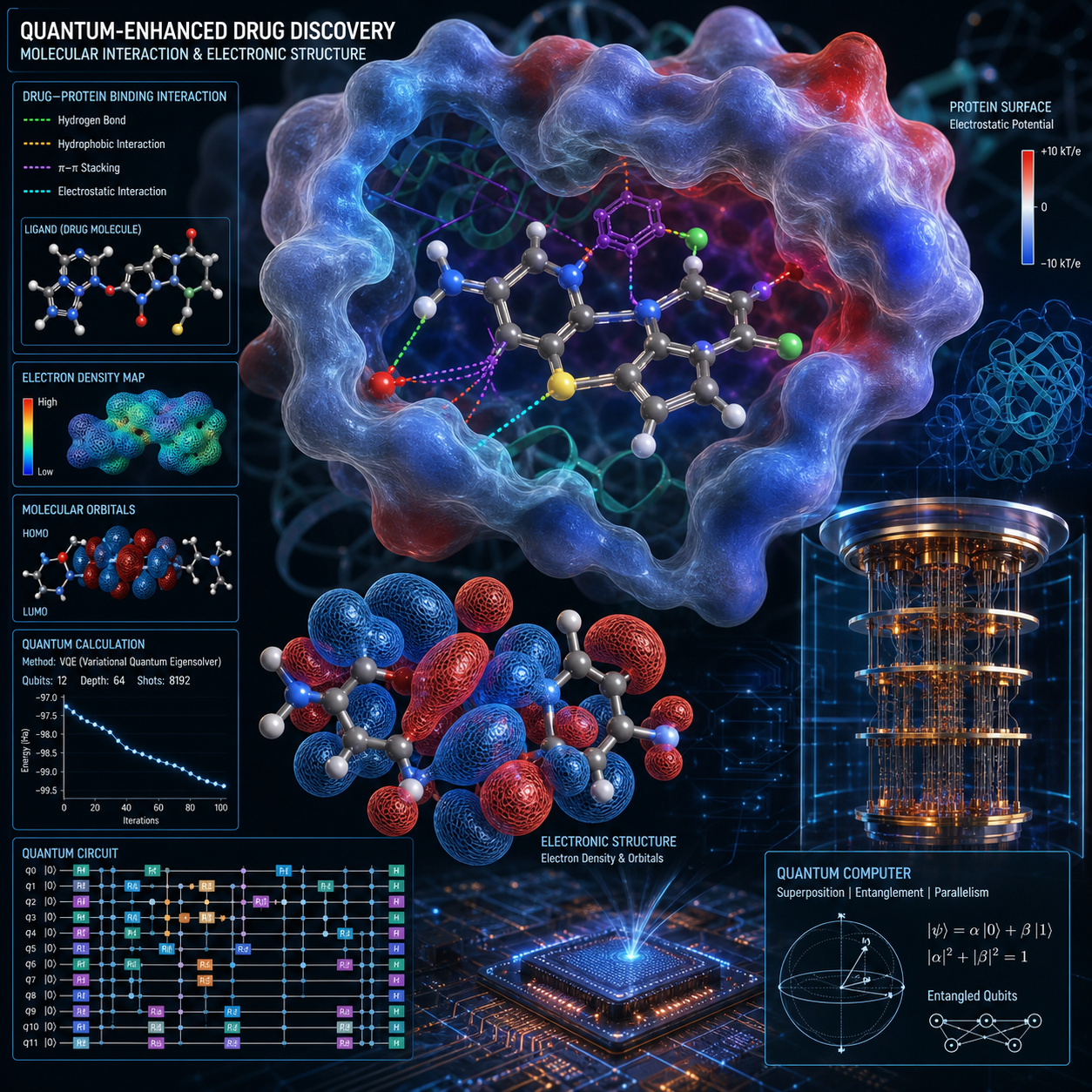
The variational quantum eigensolver (VQE) is one algorithm studied for near-term quantum chemistry. VQE uses a parameterized quantum circuit to represent a molecular state, while a classical optimizer adjusts circuit parameters to seek a lower energy. This hybrid approach is attractive because it shares work between quantum and classical processors. Its usefulness depends on circuit quality, noise, problem size, and the accuracy of the molecular model.
Even with a quantum energy estimate, docking still needs a search strategy, protein preparation, solvent treatment, and a method for comparing poses. Quantum chemistry can improve one component without resolving every source of uncertainty.
Potential benefits for pharmaceutical research
The potential benefit is better-informed prioritization when a more detailed treatment of electronic interactions changes how candidate poses or compounds are ranked. This could help researchers investigate difficult targets, but it does not guarantee faster discovery or higher clinical success.
Improved molecular energy estimates could be valuable when standard scoring functions struggle to distinguish similar compounds. For example, two ligands may fit a pocket in nearly the same way, yet differ in charge distribution or interactions with a metal center. A targeted quantum calculation might help explain that difference and guide which analogues chemists should synthesize next.
Quantum-enhanced methods may also contribute to method development. Researchers can compare quantum calculations with high-quality classical quantum chemistry on small systems, then test whether the added detail improves predictions against measured structures or binding data. This creates a concrete evaluation path instead of relying on theoretical speed claims.
The likely early value is therefore selective: applying expensive or specialized calculations to a small number of high-priority candidates after classical screening. For a large virtual library, classical docking remains far more practical. A quantum step is most compelling when the expected improvement could change a real decision, such as which compound advances to synthesis or assay.
Technical and practical limitations
Current limitations include noisy hardware, limited scale, complex data preparation, and uncertain predictive value. Until these issues are addressed, quantum-enhanced docking should be treated as an experimental complement rather than a dependable replacement for classical methods.
Today’s quantum processors have constraints on the number and quality of operations they can perform. Molecular calculations may require many qubits and deep circuits, while hardware noise can distort results. Error mitigation can help in some settings, but it adds computational cost and does not guarantee chemically accurate answers.
Scaling is another challenge. Researchers must map a molecular problem onto qubits, choose a manageable active region, and decide which surrounding atoms to simplify or omit. Those choices can make a calculation tractable, but they can also remove interactions that matter to binding. Preparing reliable protein–ligand inputs is itself difficult: protonation, water molecules, side-chain flexibility, and alternate protein conformations can all affect predicted affinity.
Validation is essential. A result that agrees with one classical calculation does not establish a practical advantage, especially if both methods share modeling assumptions. Researchers need comparisons against well-defined benchmarks, reproducible workflows, experimental structures, and measured binding data. They should also account for total resources, including circuit executions and classical processing.
A common mistake is to equate quantum hardware with automatic accuracy or speed. Another is to compare a quantum result for a tiny fragment with a classical result for a complete complex as if they were equivalent. Fair tests must use comparable systems, state assumptions, and measure whether the method improves a drug-discovery decision.
What researchers should watch next
Readiness will become clearer when quantum methods show reproducible improvements on relevant molecular benchmarks and fit into realistic pharma workflows. Hardware progress matters, but evidence that better calculations change candidate selection matters more.
Researchers and pharmaceutical teams can watch for several milestones:
- Reliable benchmark results: Independent groups reproduce quantum chemistry calculations for systems relevant to protein–ligand interactions.
- Useful scale: Methods handle larger or more chemically meaningful regions without an impractical increase in qubits, circuit depth, or execution time.
- End-to-end validation: Studies connect improved energy estimates to more accurate pose ranking, binding-affinity prediction, or experimental hit prioritization.
- Workflow integration: Quantum calculations work with established molecular modeling tools and clearly identify when their added cost is justified.
For now, the sensible strategy is to use classical docking for broad screening and evaluate quantum approaches on narrowly defined cases where electronic structure may be important. The question is not simply whether a quantum computer can calculate a molecular energy. It is whether that calculation is accurate, affordable, and useful enough to improve a decision that researchers would otherwise make.
Frequently asked questions
Does quantum computing make molecular docking faster?
Not reliably today. Quantum algorithms may eventually accelerate specific calculations, but current hardware limits and workflow costs mean that quantum-enhanced docking has not established a general speed advantage over classical docking.
Is quantum-enhanced docking used in pharmaceutical research today?
It is being explored in research and method development, especially for quantum chemistry and hybrid workflows. It is not yet a routine replacement for classical docking in pharmaceutical screening.
How does it differ from classical docking?
Classical docking uses conventional search algorithms and approximate scoring functions to generate and rank poses. Quantum-enhanced approaches seek to use quantum calculations for selected molecular properties, usually alongside classical preparation, search, and analysis.
What role do hybrid quantum-classical algorithms play?
Hybrid quantum-classical algorithms divide work between a quantum processor and a classical computer. In VQE, for example, a quantum circuit estimates molecular energy while a classical optimizer updates circuit parameters, though hardware noise and model choices still affect accuracy.