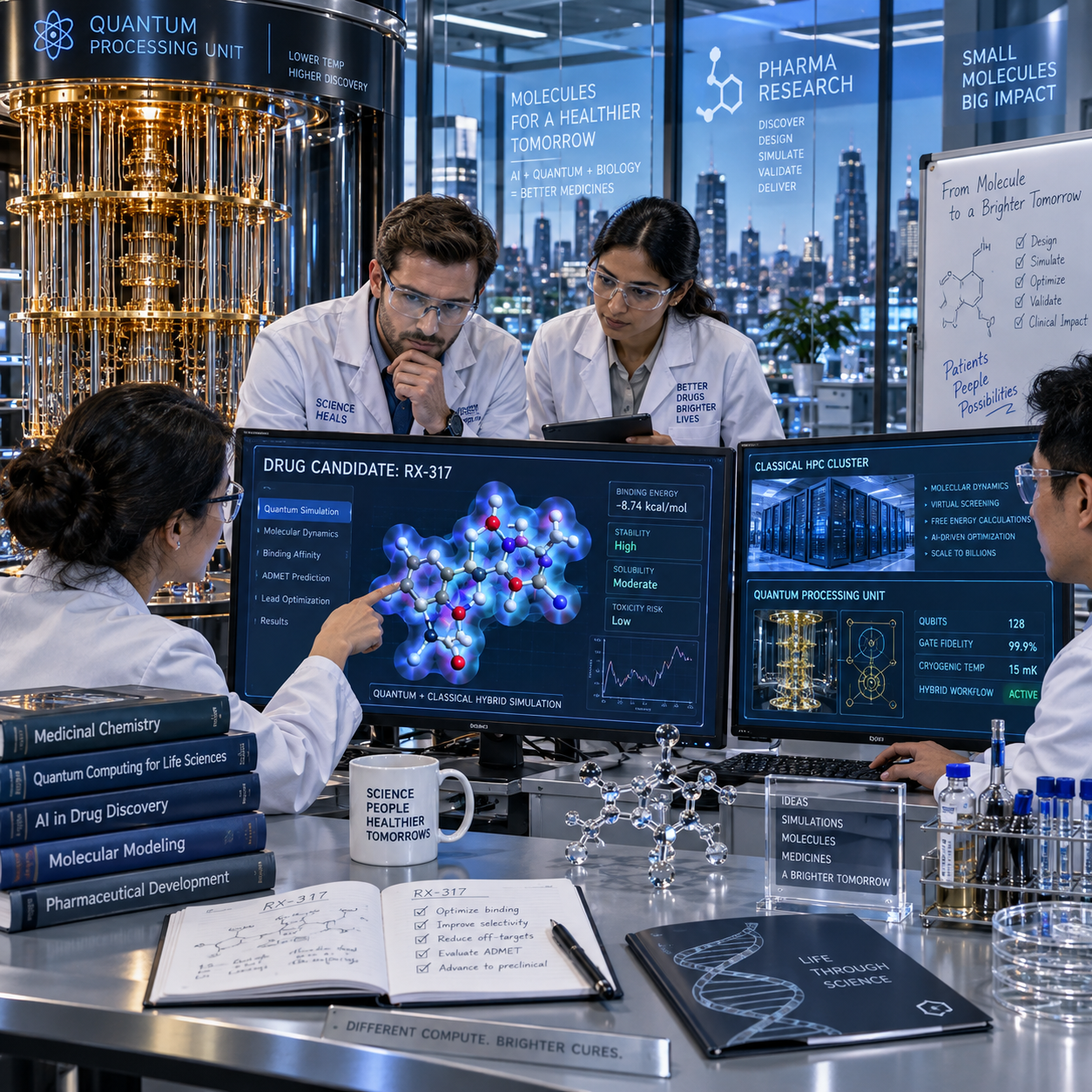

High-Throughput Screening with Quantum Computing: Transforming Drug Discovery at Scale
Drug discovery has always been a numbers game. Screen enough compounds, find the right molecule, and you might have a therapeutic candidate worth billions. But the sheer scale of modern high-throughput screening — testing millions of compounds against biological targets — is pushing classical methods to their limits. Quantum computing is emerging as a credible accelerator for this process, not a replacement for it.
The Bottleneck Problem in Classical High-Throughput Screening
Classical high-throughput screening faces three compounding challenges: cost, scale, and signal quality. Running a single large-scale HTS campaign against a compound library of one to ten million molecules can cost anywhere from $500,000 to several million dollars, and that's before accounting for the downstream cost of chasing false positives.
The core issue is combinatorial. Even a modest compound library of five million molecules, screened against a panel of targets, generates an enormous matrix of interactions that classical computers must evaluate sequentially or through heuristic shortcuts. Virtual screening methods help — they filter candidates computationally before physical assays — but classical molecular docking algorithms rely on simplified energy functions that sacrifice accuracy for speed.
False positive rates in classical HTS often run between 0.1% and 1%, which sounds small until you realize that 0.5% of five million compounds is 25,000 molecules requiring expensive follow-up validation. The real bottleneck isn't throughput in the literal sense; it's the accuracy-to-cost ratio at scale. This is precisely where quantum approaches offer a different kind of leverage.
How Quantum Computing Works in a Drug Discovery Context
Quantum computing exploits two properties — superposition and entanglement — to process information in ways classical bits cannot. A qubit can represent 0 and 1 simultaneously, and entangled qubits can encode correlations across a system that would require exponentially more classical bits to represent faithfully.
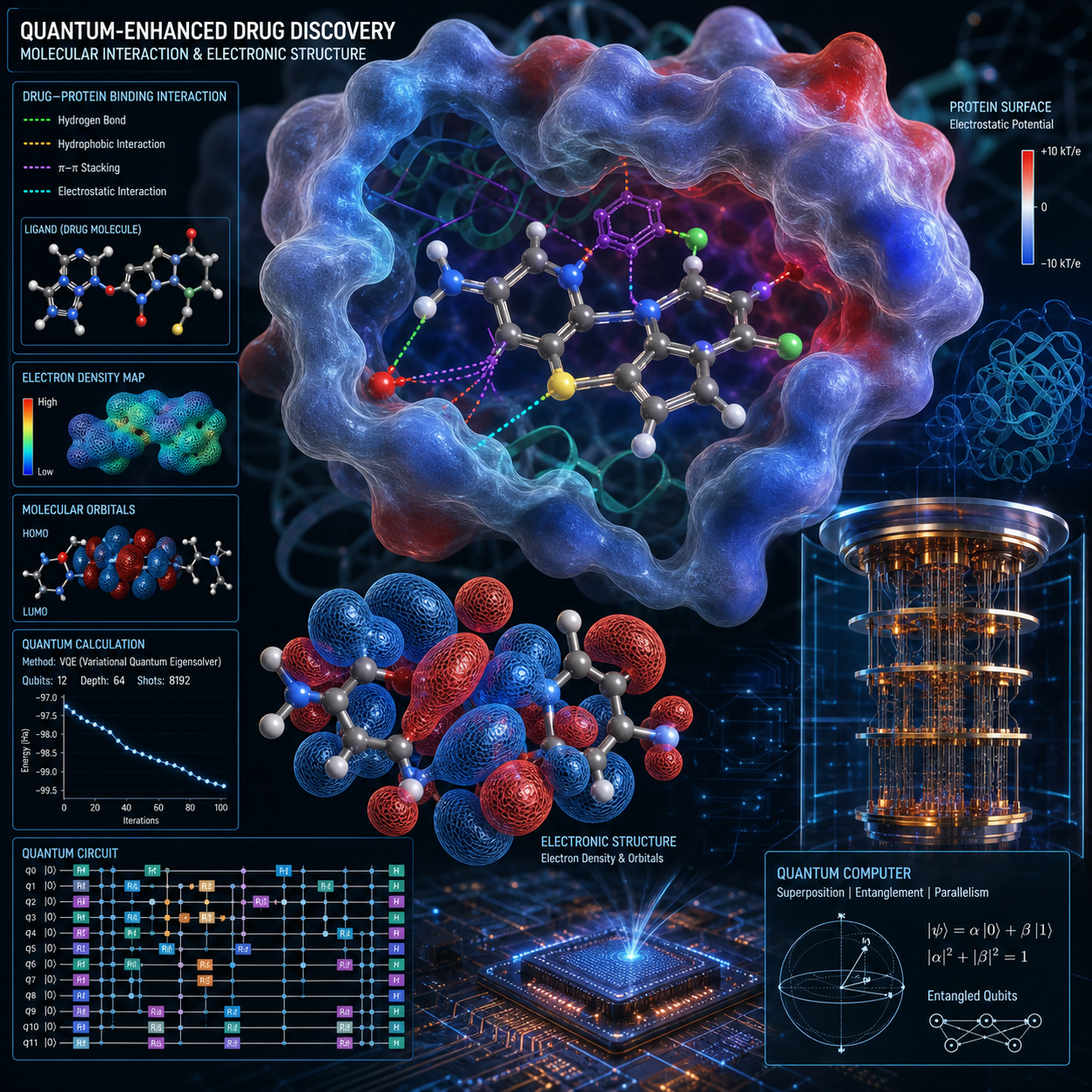
For drug discovery, the most relevant capability is quantum simulation: the ability to model quantum mechanical systems (like electrons in a molecule) using a device that is itself quantum mechanical. Classical computers simulate molecular behavior by approximating the Schrödinger equation — approximations that become increasingly inaccurate for larger, more complex molecules. A quantum computer can, in principle, represent these electronic structures exactly.
This matters for HTS because binding affinity — the strength with which a drug candidate attaches to its target protein — is fundamentally a quantum mechanical phenomenon. Better simulation means better prediction of which compounds will actually bind, before any physical experiment takes place.
Where Quantum Computing Intersects with HTS Workflows
Quantum computing doesn't slot into a single step of the HTS pipeline — it intersects at several distinct points, each with a different level of near-term readiness.
Binding Affinity Prediction via VQE
The Variational Quantum Eigensolver (VQE) is currently the most discussed near-term quantum algorithm for molecular simulation. It operates as a hybrid: a quantum processor calculates the energy of a molecular configuration, while a classical optimizer iterates toward the ground state energy. For small drug-relevant molecules, VQE can estimate binding affinities with accuracy that classical density functional theory (DFT) methods struggle to match at comparable computational cost. Companies including IBM and Google have demonstrated VQE on molecules like caffeine and small peptide fragments — modest by drug discovery standards, but the trajectory is clear.
Quantum Machine Learning for Hit Identification
Quantum machine learning (QML) takes a different angle. Rather than simulating molecular physics directly, QML applies quantum-enhanced pattern recognition to screening datasets. The hypothesis is that quantum kernels — mathematical functions used in support vector machines and similar classifiers — can identify structure-activity relationships in compound libraries that classical models miss. Early academic results suggest QML models can achieve comparable or slightly superior classification accuracy on certain molecular property prediction tasks, though the advantage over well-tuned classical deep learning remains contested on current hardware.
Quantum Annealing for Compound Library Optimization
Quantum annealing, as implemented on D-Wave hardware, approaches HTS from a combinatorial optimization angle. Selecting the most diverse and pharmacologically relevant subset of a large compound library for physical screening is itself an optimization problem. Quantum annealers have shown promise in formulating and partially solving such subset selection problems faster than classical branch-and-bound methods.
Advantages of Quantum-Enhanced Screening Over Classical Methods
The primary advantage of quantum-enhanced virtual screening is accuracy at the level of electronic structure — the layer where classical approximations accumulate the most error. For lead optimization, where the difference between a promising hit and a clinical candidate can hinge on subtle conformational or electronic effects, higher-fidelity molecular modeling translates directly into better decision-making.
A second advantage is the potential to explore larger chemical spaces more efficiently. The known drug-like chemical space is estimated at 1060 possible molecules — a number that makes exhaustive classical screening absurd. Quantum algorithms, particularly those built on amplitude amplification (a generalization of Grover's search), could in theory provide quadratic speedups when searching these spaces for molecules meeting specific property criteria.
For hit identification specifically, reducing false positive rates by even a few tenths of a percent translates into significant savings in wet-lab validation costs — potentially millions of dollars per campaign at large pharma scale.
Current Limitations and the NISQ Reality
Honest assessment matters here: NISQ devices (Noisy Intermediate-Scale Quantum processors) are not yet capable of running production HTS workflows. Current quantum processors from IBM, Google, and IonQ operate with qubit counts in the hundreds to low thousands, but error rates remain high enough that deep quantum circuits produce unreliable results without extensive error mitigation.
VQE, for all its promise, currently handles molecules of perhaps 20-50 electrons with meaningful accuracy — far smaller than most drug targets or even many lead compounds. Scaling to clinically relevant molecular systems requires either better error correction (which demands many more physical qubits per logical qubit) or fundamentally new algorithmic approaches that are tolerant of noise.
QML faces a related challenge: the quantum advantage over classical machine learning has not been definitively demonstrated on real-world screening datasets at scale. Several peer-reviewed studies have shown that classical models, given equivalent data, often match or outperform QML classifiers on current hardware. This doesn't invalidate the long-term case, but it does mean organizations should calibrate expectations carefully.
The gap between research demonstrations and production-ready pipelines is real and should not be papered over with marketing language.
Practical Steps for Pharma Organizations to Prepare
The most defensible near-term strategy is a hybrid classical-quantum approach: use quantum processors for the specific subtasks where they offer genuine accuracy advantages (small-molecule energy calculations, certain optimization problems), while keeping classical infrastructure in place for everything else.
- Audit your computational chemistry stack to identify where classical approximations introduce the most error — these are your highest-value quantum integration points.
- Build internal quantum literacy through partnerships with academic quantum chemistry groups or cloud quantum platforms (IBM Quantum, Amazon Braket, Azure Quantum) that offer access without capital hardware investment.
- Pilot VQE-based binding affinity calculations on a small set of well-characterized compound-target pairs where you have validated experimental data — this gives you a real benchmark rather than a vendor's benchmark.
- Engage with quantum software frameworks such as Qiskit, PennyLane, or OpenFermion, which have active drug discovery use-case communities and growing libraries of chemistry-relevant quantum circuits.
Avoid the mistake of waiting for "quantum-ready" hardware before doing any preparation. The organizations that will extract value from fault-tolerant quantum computers in the 2030s are the ones building quantum-aware computational workflows now.
The Road Ahead — What Fault-Tolerant Quantum Computers Will Unlock
Fault-tolerant quantum computers — systems with logical qubits protected by full error correction — remain a 5-to-15-year horizon depending on which hardware roadmap you trust. When they arrive, the implications for HTS are substantial.
Full quantum simulation of protein-ligand binding at the electronic structure level becomes feasible for systems of hundreds of atoms. This would allow binding affinity prediction with near-experimental accuracy, potentially replacing or dramatically reducing the role of physical assays in early-stage screening. Hit rates could improve from the typical 0.01-0.1% range in classical HTS to something meaningfully higher — not because more compounds are tested, but because the computational filter is far more selective.
Quantum algorithms like the quantum phase estimation algorithm could calculate molecular ground state energies with exponential speedup over classical methods for sufficiently large systems. Combined with quantum-accelerated optimization of compound libraries, the entire virtual-to-physical screening funnel could compress significantly.
The drug discovery pipeline has always rewarded whoever could generate better signal earlier in the process. Quantum computing, at full scale, represents the most significant shift in that signal quality since the introduction of computational chemistry itself.
Frequently Asked Questions
What is high-throughput screening and why does it matter in drug discovery?
High-throughput screening is an automated process for testing large numbers of chemical compounds against biological targets to identify candidates with therapeutic potential. It matters because it dramatically accelerates the early stage of drug discovery — identifying "hits" that can be developed into lead compounds — but its cost and false positive burden make it a prime candidate for computational enhancement.
Can quantum computers run HTS today, or is it still theoretical?
Current quantum hardware can contribute to specific, narrow HTS subtasks — particularly small-molecule energy calculations via VQE — but cannot run full HTS workflows. Hybrid classical-quantum pipelines represent the realistic near-term application, with production-scale quantum HTS remaining a medium-to-long-term prospect.
What is the difference between quantum simulation and quantum machine learning in this context?
Quantum simulation models the physical behavior of molecular systems using quantum mechanical principles — it's about calculating energies and interactions accurately. Quantum machine learning applies quantum-enhanced algorithms to recognize patterns in screening data, such as predicting which compound structures correlate with biological activity. They address different parts of the HTS problem.
How does quantum-enhanced virtual screening compare to AI-driven classical virtual screening?
Classical AI-driven virtual screening (using deep learning models like graph neural networks) is more mature and currently outperforms QML on most real-world benchmarks. The potential quantum advantage lies in accuracy for electronic structure calculations, not in pattern recognition on existing datasets — at least on current NISQ hardware.
What resources or infrastructure does a pharma company need to begin exploring quantum HTS?
Cloud-based quantum computing platforms remove the need for on-premise hardware investment. The primary requirements are: computational chemists with quantum algorithm literacy, access to validated compound-target datasets for benchmarking, and partnerships with quantum software vendors or academic groups. Starting with a well-defined pilot problem — rather than a broad quantum strategy — yields the most actionable early results.