Protein Folding Predictions Using Quantum Systems: What It Means for Drug Discovery
A single misfolded protein can trigger Alzheimer's disease, Parkinson's, or type 2 diabetes. The ability to predict exactly how a protein folds — and why it sometimes goes wrong — sits at the heart of modern drug design. Quantum computing is now entering this space, not as a silver bullet, but as a fundamentally different computational lens on one of biology's hardest problems.
Why Protein Folding Is a Critical Bottleneck in Drug Development
Protein folding determines how a drug target behaves. Without knowing a protein's three-dimensional structure, designing a molecule that binds to it is essentially guesswork at the molecular level.
Proteins are chains of amino acids that spontaneously collapse into precise shapes within milliseconds of synthesis. That shape governs everything: enzymatic activity, receptor binding, immune signaling. When folding goes wrong, the resulting misfolded proteins can aggregate into toxic clumps — the hallmark of neurodegenerative diseases — or lose their functional geometry entirely, making them impossible to target with conventional drugs.
For pharmaceutical teams, this creates a concrete pipeline problem. Identifying a disease-relevant protein target is only the first step. Characterizing its folded structure, understanding its conformational flexibility, and predicting how it responds to candidate molecules are separate, time-consuming challenges. Experimental techniques like X-ray crystallography and cryo-electron microscopy are expensive and slow. Computational prediction, when accurate, can compress months of structural biology work into days.
The stakes are high enough that even marginal improvements in folding prediction accuracy translate directly into better drug candidates entering clinical trials — and fewer expensive late-stage failures.
The Limits of Classical Approaches to Folding Prediction
Classical computing methods struggle with protein folding because the conformational search space grows exponentially with protein length. Even a modestly sized protein with 100 amino acids has an astronomical number of possible geometric configurations.
Molecular dynamics (MD) simulations — the current workhorse of computational structural biology — model atomic interactions by numerically integrating Newton's equations of motion. They're powerful, but they operate on a fundamental constraint: time. Folding events that occur over microseconds or milliseconds in biology require simulations that can take weeks or months on high-performance computing clusters, even with specialized hardware like Anton supercomputers.
Force fields, the mathematical models underlying MD simulations, introduce another layer of approximation. They treat quantum mechanical effects — electron behavior, bond formation, polarization — through simplified classical approximations. For most structural questions this works reasonably well, but for problems requiring high-energy-precision answers (binding affinity calculations, transition state modeling), those approximations accumulate into meaningful errors.
The deeper issue is that the energy landscape of a folding protein is rugged and high-dimensional. Classical optimization algorithms can get trapped in local energy minima, missing the true lowest-energy native state. Sampling this landscape thoroughly enough to be confident in a prediction is computationally prohibitive for all but the smallest proteins.
How Quantum Systems Approach the Folding Problem
Quantum systems are theoretically suited to protein folding because they can natively represent and explore exponentially large solution spaces in ways classical bits cannot.
The relevant quantum mechanical properties are superposition, entanglement, and tunneling. A classical bit is either 0 or 1. A qubit can exist in a superposition of both states simultaneously, allowing a quantum processor to encode and manipulate many configurations at once. Entanglement links qubits so that the state of one instantly informs the state of another — enabling compact representation of correlated molecular geometries that would require exponential classical memory to describe explicitly.
Quantum tunneling is particularly relevant to energy landscape navigation. Classical optimization must climb over energy barriers to escape local minima. Quantum systems can tunnel through barriers, potentially finding lower-energy configurations — including the native folded state — without getting stuck in the way classical algorithms do.
For protein folding specifically, this means quantum processors could in principle sample conformational space more efficiently, calculate molecular energies with higher fidelity by treating electrons quantum mechanically rather than through force-field approximations, and optimize folding pathways in ways that are intractable classically.
Key Quantum Algorithms in Protein Folding Research
Two quantum algorithmic approaches dominate current research: the Variational Quantum Eigensolver (VQE) and quantum annealing, with hybrid quantum-classical methods bridging both toward near-term practicality.
Variational Quantum Eigensolver (VQE)
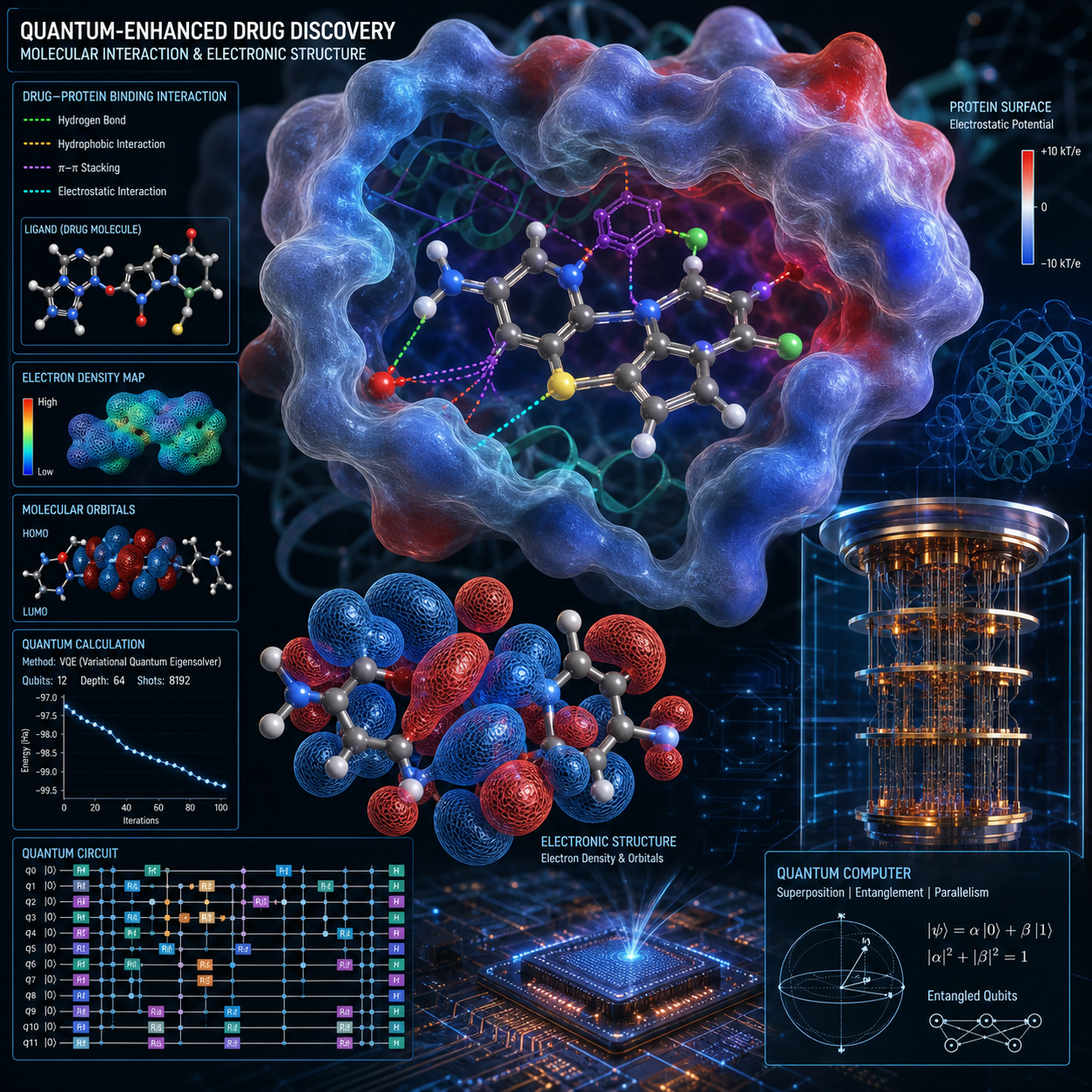
VQE is designed to find the ground-state energy of a quantum system — exactly the calculation needed to determine a protein's most stable folded configuration. It works by using a quantum processor to prepare a trial quantum state (an "ansatz"), measure its energy, and then use a classical optimizer to iteratively adjust the quantum circuit parameters until the energy is minimized.
In drug discovery terms, VQE offers a path to calculating molecular energies with quantum mechanical accuracy, rather than through classical force-field approximations. This matters most for problems where electron correlation effects are significant — reaction mechanisms, metalloprotein active sites, covalent drug binding. Current demonstrations remain limited to small molecules (a few dozen atoms), but the algorithmic framework is sound.
Quantum Annealing
Quantum annealing takes a different approach. Rather than gate-based circuit computation, it encodes an optimization problem into a physical Hamiltonian and lets the system evolve toward its lowest-energy state through controlled quantum fluctuations. D-Wave's hardware is the primary commercial implementation of this paradigm.
For protein folding, annealing is well-matched to conformational sampling problems — finding low-energy arrangements among a discrete set of possible backbone configurations. Researchers have demonstrated annealing-based folding on simplified lattice models, which reduce the continuous folding problem to a tractable discrete optimization. These are proof-of-concept demonstrations, not production-ready tools, but they validate the conceptual approach.
Hybrid Quantum-Classical Methods
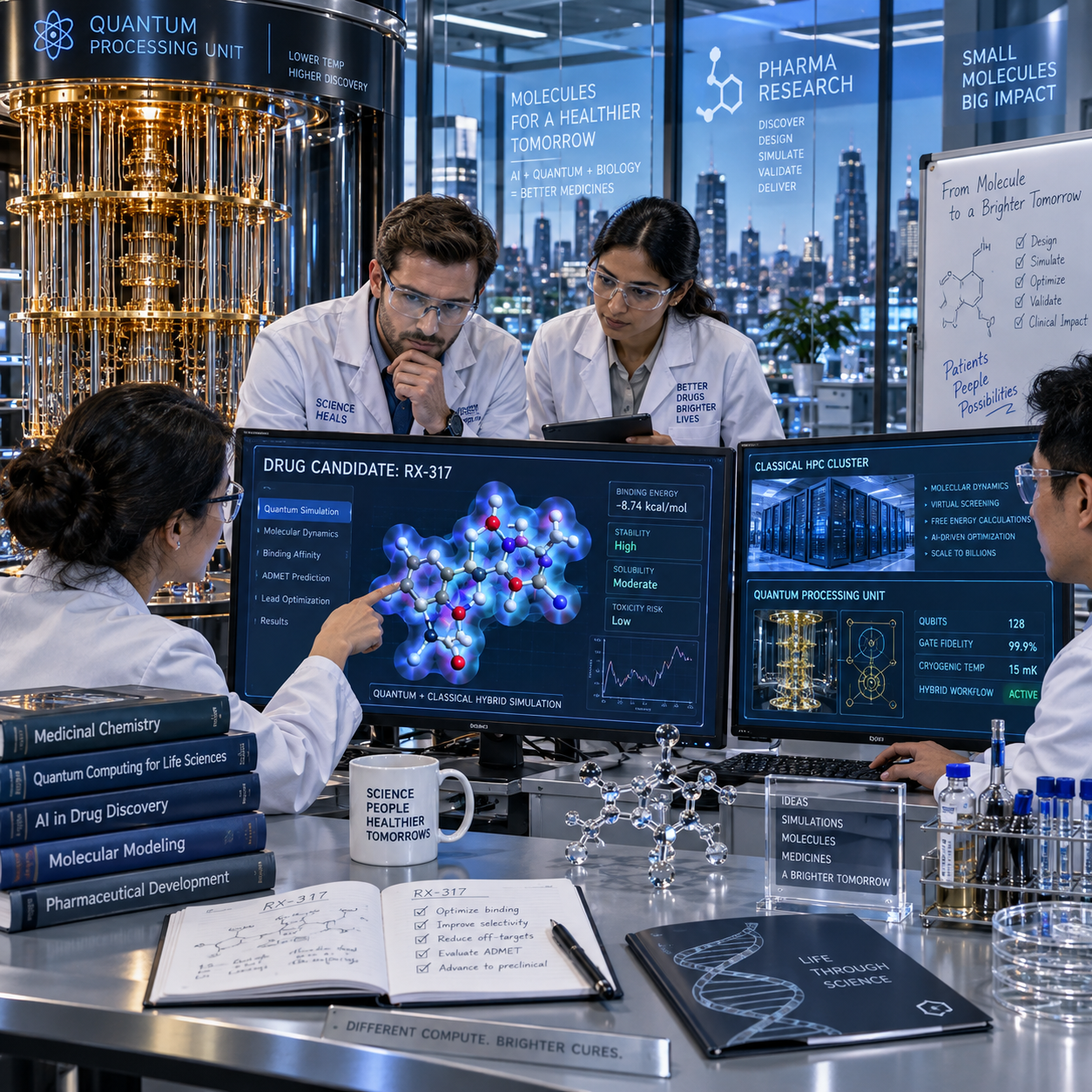
Given current hardware constraints, the most realistic near-term path runs through hybrid approaches: quantum processors handle the computationally intensive quantum mechanical calculations (energy estimation, sampling), while classical computers manage optimization loops, data processing, and system control. This division of labor plays to each technology's strengths and is the dominant research strategy across both academic and industry quantum computing programs today.
Where Quantum Folding Predictions Stand Today (NISQ Era Realities)
Honestly: quantum computers have not predicted any real protein structure. Current demonstrations are proof-of-concept experiments on highly simplified models, not tools ready for pharmaceutical pipelines.
We are in the Noisy Intermediate-Scale Quantum (NISQ) era — a hardware regime characterized by processors with tens to a few thousand qubits, significant error rates, and limited coherence times. The noise problem is serious: quantum states degrade rapidly, and errors accumulate across circuit operations. Error correction requires enormous qubit overhead (estimates suggest thousands of physical qubits per logical qubit), which is far beyond current hardware.
What has been demonstrated at small scale includes VQE calculations on molecules with a handful of atoms, lattice-model protein folding on quantum annealers with simplified residue representations, and hybrid algorithms that show correct behavior on toy problems. These results are scientifically meaningful — they validate that the algorithms work in principle — but they involve proteins reduced to 10-20 residues on abstract lattices, not the 200-500 residue proteins relevant to most drug targets.
The gap between current capability and pharmaceutical utility is real and should not be minimized. Reaching the qubit counts and error rates needed for genuine folding advantage likely requires fault-tolerant quantum hardware, which most roadmaps place 10-15 years out. Hybrid NISQ approaches may deliver incremental value sooner, particularly for specific sub-problems like binding energy calculations.
Quantum vs. AI-Based Folding Tools — Complementary, Not Competing
Quantum computing and AI tools like AlphaFold address different layers of the protein folding problem — they are not competing for the same solution space.
AlphaFold2 and its successors have been genuinely transformative. By training on the Protein Data Bank's library of experimentally solved structures, these models can predict static folded structures for many proteins with near-experimental accuracy. For drug discovery teams, this has already changed how target identification and structural biology work.
But AlphaFold has known limitations that quantum methods are specifically positioned to address. It predicts a single static structure, while proteins are dynamic — they breathe, flex, and adopt multiple conformations relevant to drug binding. It struggles with intrinsically disordered proteins, protein-protein interaction interfaces, and cases where the training data is sparse. Most critically, it doesn't calculate energies from first principles, which limits its use for quantitative binding affinity prediction.
Quantum approaches target precisely these gaps: energy precision, dynamic conformational behavior, and quantum mechanical accuracy for electron-level phenomena. A realistic future scenario has AI tools providing fast structural predictions that feed into quantum calculations for high-accuracy energy refinement — a layered workflow rather than a competition.
Implications for the Pharmaceutical Technology Roadmap
Pharma companies are not waiting for fault-tolerant quantum hardware to start positioning. The near-term opportunity lies in hybrid quantum-classical workflows integrated into existing computational chemistry pipelines.
Several large pharmaceutical companies — including Roche, Pfizer, and AstraZeneca — have established quantum computing research partnerships with hardware developers like IBM, IonQ, and D-Wave. These collaborations focus on identifying specific computational bottlenecks in drug discovery where quantum methods might provide incremental advantage on near-term hardware: binding free energy calculations, molecular property prediction, and optimization of lead compounds.
The milestone that would signal genuine quantum advantage in this domain is narrow but meaningful: a quantum calculation that produces a more accurate binding energy prediction than the best classical method, for a pharmaceutically relevant molecule, in comparable or less time. That bar has not been cleared yet, but the scientific trajectory is credible.
For pharmaceutical technology teams, the practical implication is to build quantum literacy now — not to deploy quantum solutions tomorrow, but to be positioned when the hardware matures. Understanding which computational problems in your pipeline are candidates for quantum acceleration, and which are not, will matter when the technology crosses the threshold from research curiosity to operational tool.
Frequently Asked Questions
What is the difference between quantum computing and AI for protein folding predictions?
AI tools like AlphaFold use pattern recognition on existing structural data to predict static protein shapes quickly. Quantum computing aims to calculate molecular energies and dynamics from quantum mechanical first principles, targeting accuracy and dynamic behavior rather than fast structural prediction. They address different aspects of the problem and are best understood as complementary technologies.
Has quantum computing successfully predicted any protein structure yet?
Not in any pharmaceutically meaningful sense. Demonstrations have been limited to highly simplified lattice models of short peptide sequences on quantum annealers, and small-molecule energy calculations using VQE. These validate the algorithmic concepts but are far from the capabilities needed for real drug discovery applications.
What is quantum advantage and when might it apply to drug discovery?
Quantum advantage means a quantum computer solves a specific problem faster or more accurately than any classical computer can. For drug discovery, this would likely appear first in molecular energy calculations for small, chemically complex systems — possibly within 5-10 years for narrow use cases, and broader folding applications likely require fault-tolerant hardware beyond that timeframe.
How does quantum annealing differ from gate-based quantum computing for folding problems?
Gate-based quantum computing (used for VQE) applies sequences of quantum logic operations to qubits, offering general-purpose computation. Quantum annealing encodes an optimization problem directly into a physical system and finds the minimum energy state through quantum fluctuations. Annealing is specialized for discrete optimization problems like conformational sampling; gate-based systems are more flexible but currently more error-prone for complex calculations.
Will quantum folding predictions replace molecular dynamics simulations?
Unlikely, at least not for a long time. MD simulations are mature, well-validated, and continuously improving with GPU acceleration and machine learning force fields. Quantum methods are more likely to augment MD — providing higher-accuracy energy calculations for specific regions of interest — than to replace the broader simulation workflow. The two approaches will probably coexist and integrate rather than one superseding the other.