Quantum Machine Learning in Pharmacology: Transforming Drug Discovery from the Ground Up
What Is Quantum Machine Learning and Why Does Pharmacology Need It?
Quantum machine learning (QML) is the integration of quantum computing principles — superposition, entanglement, and quantum interference — with machine learning algorithms to process and analyze data in ways classical computers cannot efficiently replicate. In pharmacology, this matters because the molecular world is inherently quantum mechanical, and classical computational tools are increasingly strained by its complexity.
Drug discovery is expensive, slow, and failure-prone. Bringing a single new drug to market costs an estimated $1–2 billion and takes over a decade, with clinical attrition rates above 90% for compounds entering Phase I trials. A significant portion of that failure stems from poor early-stage predictions: the wrong target, an unstable molecule, or toxicity that only surfaces late in development.
Classical machine learning has made genuine inroads — predicting binding affinities, flagging toxic substructures, accelerating virtual screening. But it hits a wall when molecules grow complex. Accurately modeling electron interactions in a mid-sized drug candidate requires computational resources that scale exponentially on classical hardware. Quantum systems, by contrast, can represent quantum states natively. That's the core argument for QML in computational pharmacology: not that it's faster at the same tasks, but that it can tackle problems that are structurally intractable for classical methods.
How Quantum ML Differs from Classical ML in a Drug Discovery Context
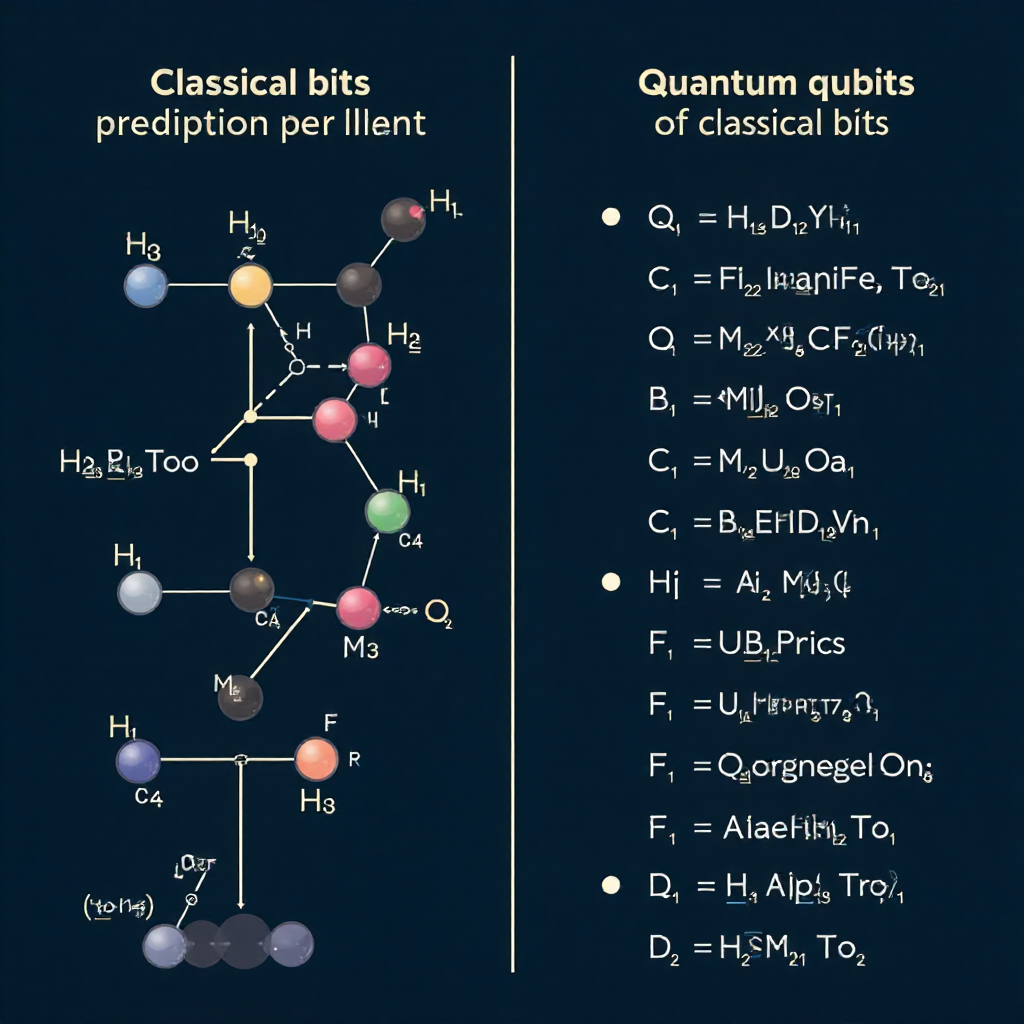
The key distinction is how information is represented and processed. Classical ML encodes data as bits — binary 0s and 1s — and learns patterns through matrix operations on large datasets. QML uses qubits, which can exist in superposition (simultaneously representing 0 and 1) and become entangled with other qubits, creating correlations that have no classical equivalent.
For molecular data, this distinction is practically significant. A molecule's electronic structure — the arrangement of electrons that governs reactivity, binding behavior, and stability — is a quantum phenomenon. When classical ML models predict molecular properties, they're essentially learning statistical proxies for an underlying quantum reality. QML can, in principle, model that reality more directly.
Quantum neural networks (QNNs) are one concrete expression of this. They use parameterized quantum circuits as trainable models, with quantum gates playing the role of weights in a classical neural network. Early research suggests QNNs may achieve certain learning tasks with fewer parameters than equivalent classical networks — though this advantage is highly problem-dependent and not yet demonstrated at pharmaceutical scale.
Entanglement also enables QML models to capture long-range correlations between distant atoms in a molecule — something classical graph neural networks approximate but don't inherently encode. Whether this translates to better predictions in practice remains an active research question, but the theoretical grounding is sound.
Key Applications of QML Across the Drug Discovery Pipeline
QML touches the drug discovery pipeline at multiple stages, each with distinct technical requirements and near-term feasibility.
Molecular Simulation and Quantum Chemistry
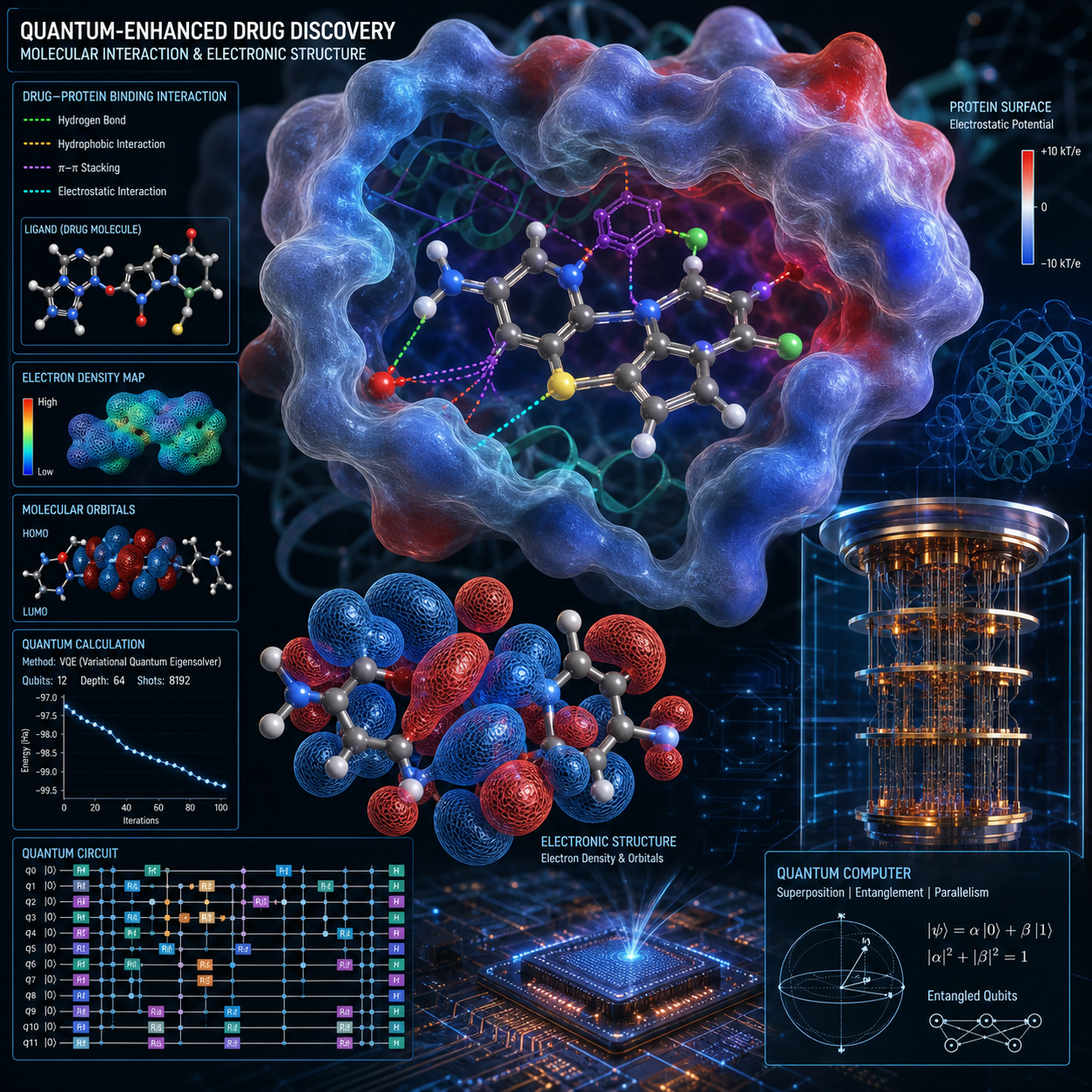
Molecular simulation is where quantum computing has the clearest theoretical edge. Accurately computing the ground-state energy of a molecule — essential for predicting how it will behave — requires solving the Schrödinger equation, which scales exponentially with molecular size on classical hardware. The variational quantum eigensolver (VQE) is a hybrid algorithm designed specifically for this: it uses a quantum processor to prepare trial molecular states and a classical optimizer to iteratively minimize energy, converging on accurate electronic structure calculations.
VQE has been demonstrated on small molecules like hydrogen and lithium hydride. Scaling to drug-relevant molecules (typically 30–100+ heavy atoms) remains a hardware challenge, but the algorithmic foundation is established.
Target Identification and Protein-Ligand Binding
Protein-ligand binding prediction — determining whether a candidate molecule will bind to a biological target with sufficient affinity and selectivity — is one of the most computationally demanding tasks in early-stage drug discovery. QML models, particularly those encoding molecular graphs into quantum feature spaces, are being explored as a way to improve binding affinity predictions beyond what classical deep learning achieves on sparse experimental datasets.
Target identification itself involves sifting through genomic, proteomic, and pathway data to find disease-relevant proteins. Quantum-enhanced clustering and classification algorithms may help identify novel targets in high-dimensional biological datasets, though this application is earlier-stage than molecular simulation work.
ADMET Prediction
ADMET properties — absorption, distribution, metabolism, excretion, and toxicity — are the gatekeepers of clinical viability. A compound that binds its target brilliantly but gets metabolized too quickly, accumulates in the wrong tissue, or triggers liver toxicity will fail. Classical ML models for ADMET prediction have improved substantially, but they're trained on limited experimental data and struggle with chemical novelty.
QML approaches to ADMET prediction use quantum feature maps to encode molecular descriptors into high-dimensional Hilbert spaces, potentially capturing structure-property relationships that classical kernels miss. Early benchmarks show modest but measurable improvements on specific endpoints — though the field hasn't yet produced a definitive demonstration of quantum advantage on ADMET tasks at scale.
Hybrid Quantum-Classical Approaches: The Practical Bridge
Fully quantum solutions are not the near-term reality — and hybrid quantum-classical algorithms are the practical path forward. Current quantum hardware, classified as noisy intermediate-scale quantum (NISQ) devices, has limited qubit counts (typically tens to hundreds of qubits), high error rates, and short coherence times. Running a fully quantum drug discovery workflow on NISQ hardware isn't feasible today.
Hybrid algorithms split the computational workload: quantum processors handle the parts of a problem where they offer a genuine advantage (typically the quantum chemistry calculations or feature encoding), while classical computers handle optimization, data preprocessing, and post-processing. VQE is the canonical example — the quantum circuit evaluates energies, the classical optimizer adjusts parameters.
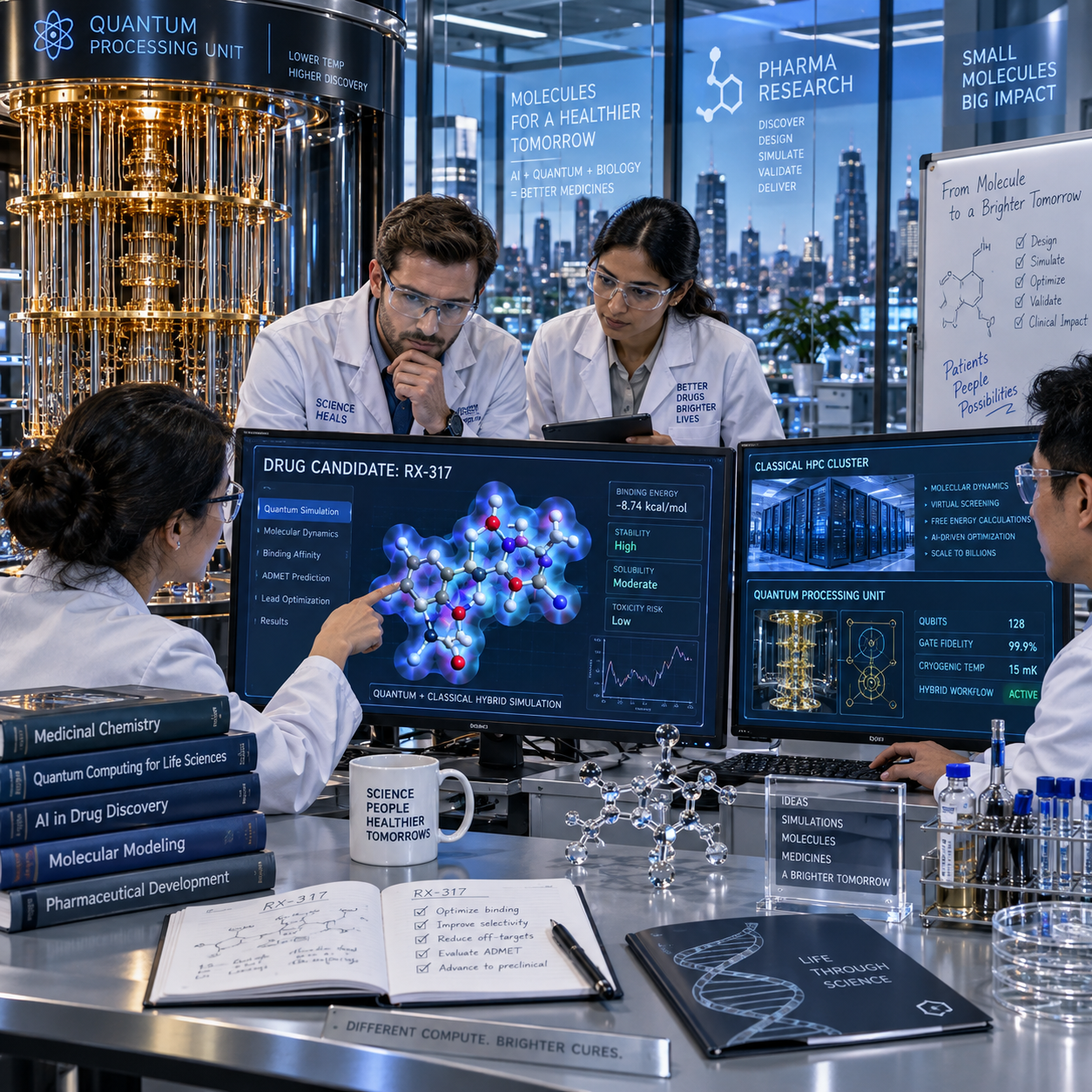
In practice, pharmaceutical companies and research groups are embedding hybrid QML modules into existing computational chemistry pipelines. A classical molecular dynamics simulation might hand off a specific binding pocket calculation to a quantum subroutine, then receive the result back for integration into a broader scoring function. This modular approach lets organizations build quantum capability incrementally without requiring a full infrastructure overhaul.
Cloud-based quantum computing platforms — IBM Quantum, Google Quantum AI, Amazon Braket — make this accessible without owning hardware. Pharma teams can run hybrid workflows on cloud QPUs today, paying per circuit execution rather than maintaining on-premise quantum systems.
Current Limitations and Open Challenges
QML in pharmacology faces real, substantive obstacles — and honest assessment of these is essential for anyone evaluating the technology's near-term role.
- Hardware noise and decoherence: NISQ devices introduce errors that accumulate across deep circuits. For molecular simulations requiring many gate operations, noise can overwhelm the signal. Error mitigation techniques exist but add overhead and complexity.
- Qubit scalability: Drug-relevant molecules require far more qubits than current hardware provides — especially when accounting for error correction overhead. Fault-tolerant quantum computing, which could address this, likely requires thousands of physical qubits per logical qubit.
- Data encoding bottlenecks: Loading classical molecular data (SMILES strings, 3D coordinates, experimental measurements) into quantum states is non-trivial. Inefficient encoding can erase any quantum speedup before computation even begins.
- Benchmarking gaps: Demonstrating genuine quantum advantage over the best classical methods — not just quantum vs. simple baselines — remains elusive for most pharmacological tasks. Rigorous head-to-head comparisons are scarce.
- Talent scarcity: The intersection of quantum physics, machine learning, and medicinal chemistry is a narrow Venn diagram. Building interdisciplinary teams capable of advancing QML in drug discovery is a real organizational challenge for pharma companies.
None of these challenges are permanent barriers, but they set realistic expectations for what QML can deliver in the next two to three years versus what might emerge over a longer horizon.
Where Is the Field Headed? Near-Term Milestones to Watch
The next three to five years will be defined by incremental but meaningful progress rather than a sudden quantum leap. Several specific developments will signal whether QML is maturing into a genuine pharmaceutical tool.
Error correction progress is the most consequential variable. Google's 2023 demonstration of below-threshold error rates in surface codes was a significant milestone. As logical qubit counts grow, the types of molecular calculations feasible on quantum hardware will expand correspondingly — potentially reaching small drug fragments within this window.
Algorithm development is moving in parallel. Researchers are designing QML models that extract maximum value from shallow circuits — suited to NISQ constraints — rather than waiting for fault-tolerant hardware. Techniques like quantum kernel methods and variational quantum classifiers are being refined specifically for molecular property prediction tasks.
On the industry side, partnerships between quantum hardware companies and pharmaceutical organizations are accelerating. Roche, Boehringer Ingelheim, and Biogen have each announced or participated in quantum computing research initiatives. These collaborations generate the real-world problem sets and experimental data needed to benchmark QML approaches honestly.
The realistic near-term scenario: QML becomes a specialized tool within computational pharmacology workflows — valuable for specific quantum chemistry calculations and high-dimensional molecular classification tasks — rather than a wholesale replacement for classical methods. That's a meaningful contribution to a field where even marginal improvements in early-stage prediction accuracy translate to billions of dollars in avoided late-stage failures.
Frequently Asked Questions
What types of molecular problems are best suited to quantum machine learning?
Problems involving electronic structure calculations — ground-state energies, reaction pathways, electron correlation in binding pockets — are the strongest candidates. These are inherently quantum mechanical and scale poorly on classical hardware. High-dimensional molecular classification tasks, where quantum feature maps may offer expressivity advantages, are a secondary area of active research.
Do pharmaceutical companies need their own quantum hardware to benefit from QML?
No. Cloud-based quantum platforms from IBM, Google, and Amazon provide access to quantum processors on a pay-per-use basis. Most pharmaceutical QML research today runs on cloud QPUs integrated with classical HPC infrastructure — no on-premise quantum hardware required.
How does QML improve ADMET prediction compared to classical deep learning?
QML approaches encode molecular features into quantum feature spaces that may capture structure-property relationships classical kernels approximate less efficiently. Early results on specific ADMET endpoints show modest improvements, particularly for datasets where chemical diversity is high and experimental data is sparse. The advantage is not universal and remains an active research area.
What is a variational quantum eigensolver and how is it used in drug design?
A variational quantum eigensolver (VQE) is a hybrid algorithm that uses a quantum processor to evaluate the energy of trial molecular states and a classical optimizer to iteratively improve those states toward the true ground-state energy. In drug design, VQE enables more accurate electronic structure calculations for binding site interactions than classical approximations allow — particularly for systems where electron correlation is strong.
Is quantum machine learning in pharmacology ready for real-world clinical applications?
Not yet, at clinical scale. QML is currently a research-stage technology contributing to early-stage computational workflows — molecular simulation, virtual screening, property prediction. It is not yet integrated into regulatory submissions or clinical trial design. The realistic timeline for meaningful clinical impact depends on hardware progress in error correction and demonstrated quantum advantage on pharmaceutical-scale problems, which most experts place at five to ten years out for high-impact applications. For a broader overview of quantum computing fundamentals, the Wikipedia entry on quantum computing provides useful context on the underlying hardware landscape.