
Hybrid Quantum-Classical Computing Approaches in Pharmaceutical Research

Hybrid quantum-classical computing approaches combine a quantum processing unit (QPU) with conventional processors to tackle selected parts of a pharmaceutical research problem. The classical system manages data, optimization, and workflow control, while the QPU evaluates quantum circuits that may represent difficult molecular or chemical calculations.
This division of labor matters because current quantum computers remain noisy, small, and expensive to operate at scale. In drug discovery, hybrid computing is therefore best viewed as an extension of established computational chemistry pipelines rather than a replacement for high-performance classical computing.
What Is Hybrid Quantum-Classical Computing?
Hybrid quantum-classical computing is a workflow in which classical computing and quantum computing repeatedly exchange information to solve one problem. Classical processors handle tasks such as data preparation and parameter optimization, while the QPU performs a targeted quantum calculation.
Pharmaceutical molecules are governed by quantum mechanics, particularly through electron correlation, molecular orbitals, and chemical bonding. Classical methods such as density functional theory, molecular mechanics, molecular dynamics, and coupled-cluster calculations remain highly valuable, but each involves trade-offs between accuracy, system size, and computational cost.
A hybrid approach assigns each subtask to the technology better suited to it. A classical computer may select molecular structures, prepare an initial state, optimize circuit parameters, and compare candidate results. The quantum processor may then estimate an energy expectation value for a carefully defined molecular Hamiltonian.
The aim is not to make every part of drug discovery quantum. It is to test whether a quantum calculation can improve a bottleneck while preserving the scalability and reliability of classical software.
For an overview of quantum-computing concepts and terminology, researchers can consult the National Institute of Standards and Technology quantum information resources.
How Hybrid Quantum-Classical Workflows Operate
Hybrid quantum-classical workflows operate as an iterative loop: prepare the problem classically, run a parameterized quantum circuit, evaluate the output, and update the circuit for another iteration.
A typical pharmaceutical workflow includes these stages:
- Define the research question. The team may seek a molecular ground-state energy, compare conformers, estimate a reaction property, or optimize a drug candidate against several constraints.
- Prepare molecular data. Classical chemistry software converts molecular structures into a representation suitable for simulation. This can include basis-set selection, active-space definition, Hamiltonian construction, and initial parameter choices.
- Execute a quantum circuit. The QPU runs a parameterized circuit and measures its output many times. Repeated measurements are required because quantum results are probabilistic.
- Evaluate results classically. A classical optimizer calculates an objective function, such as estimated molecular energy, and determines whether the current parameters are improving the result.
- Refine and repeat. Updated parameters return to the QPU until the workflow reaches a stopping condition, such as a convergence threshold or a fixed measurement budget.
Data movement can become a serious part of the cost. A circuit may be short, yet the complete process can require thousands of measurements, network calls, optimizer steps, and error-mitigation operations. In practice, teams should measure the full wall-clock workflow rather than judging a QPU by circuit execution time alone.
Key Hybrid Algorithms for Quantum Chemistry and Drug Discovery
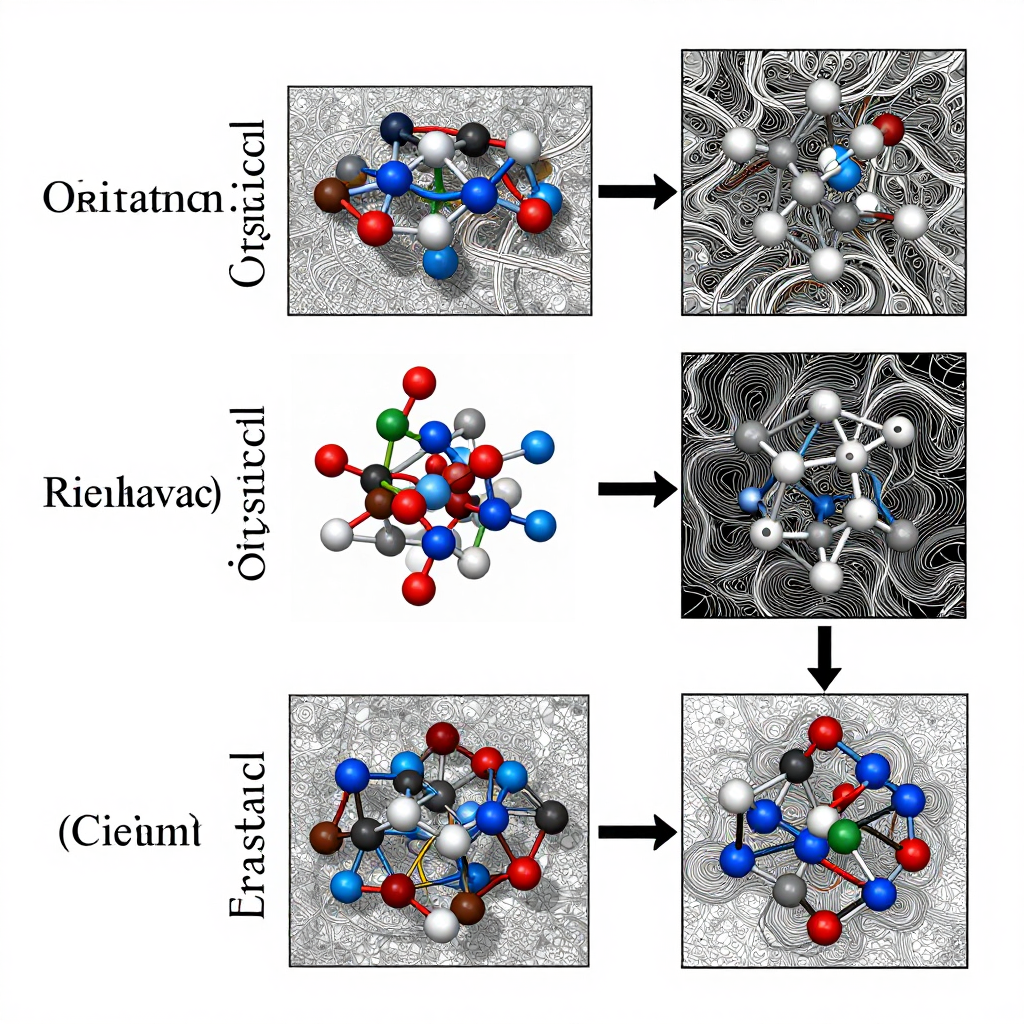
Variational quantum algorithms are the main hybrid algorithm family for near-term quantum chemistry because they allow a classical optimizer to tune a parameterized quantum circuit. Their potential lies in estimating molecular properties with circuits designed around the chemistry of the target system.
Variational quantum eigensolver
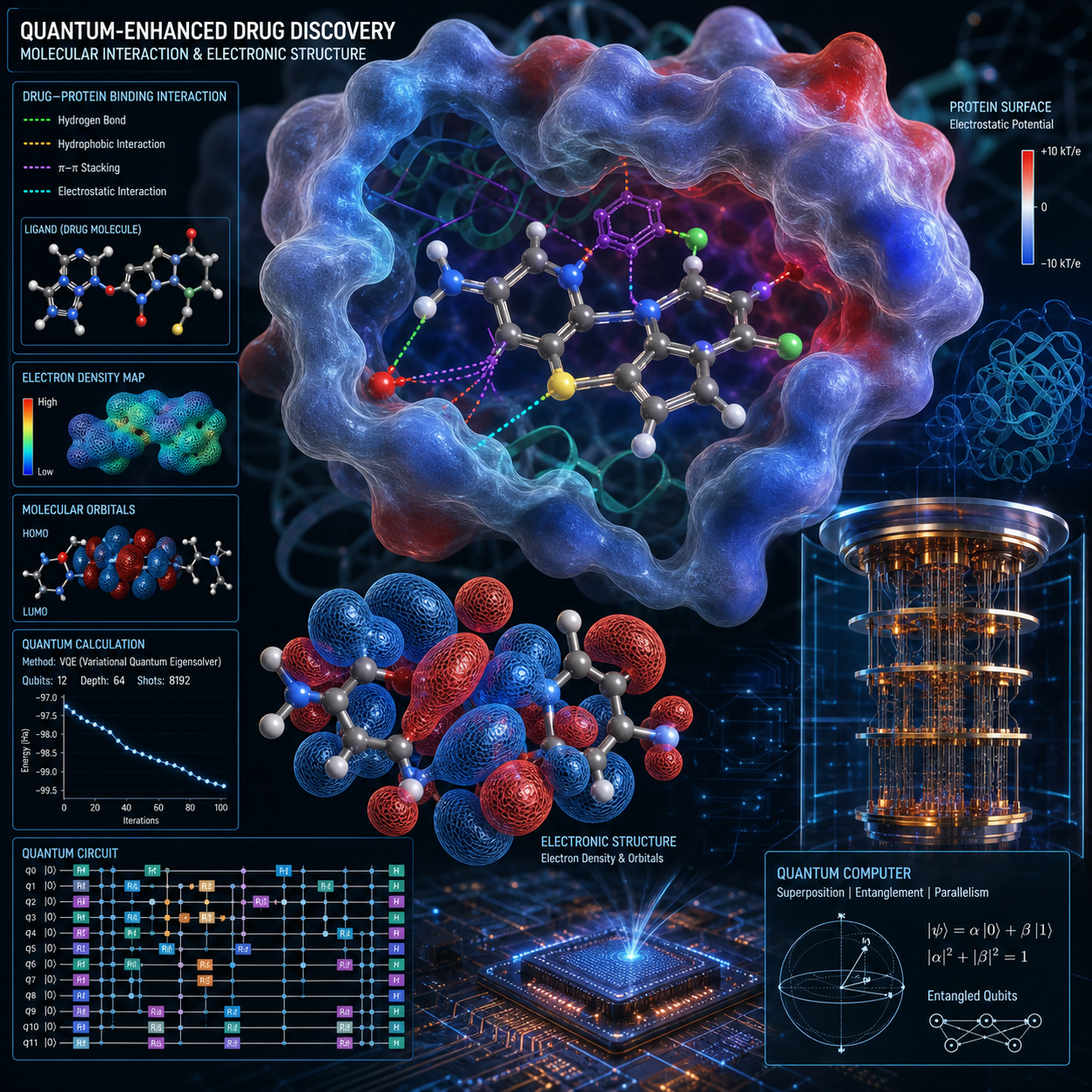
The variational quantum eigensolver, or VQE, estimates the ground-state energy of a molecule. A classical computer proposes circuit parameters, the QPU measures the corresponding energy, and the optimizer searches for a lower value. In principle, this can support molecular simulation and electronic-structure analysis.
VQE performance depends heavily on the chosen ansatz, active space, measurement strategy, optimizer, and error-mitigation method. A chemically informed circuit may reduce unnecessary complexity, while an overly flexible circuit can create optimization problems and consume more hardware resources.
Quantum approximate optimization and quantum machine learning
Quantum approximate optimization algorithm variants may be relevant to discrete molecular optimization tasks, such as selecting fragments or making constrained design choices. Quantum machine learning models, including parameterized quantum classifiers and quantum kernels, may also support molecular property prediction.
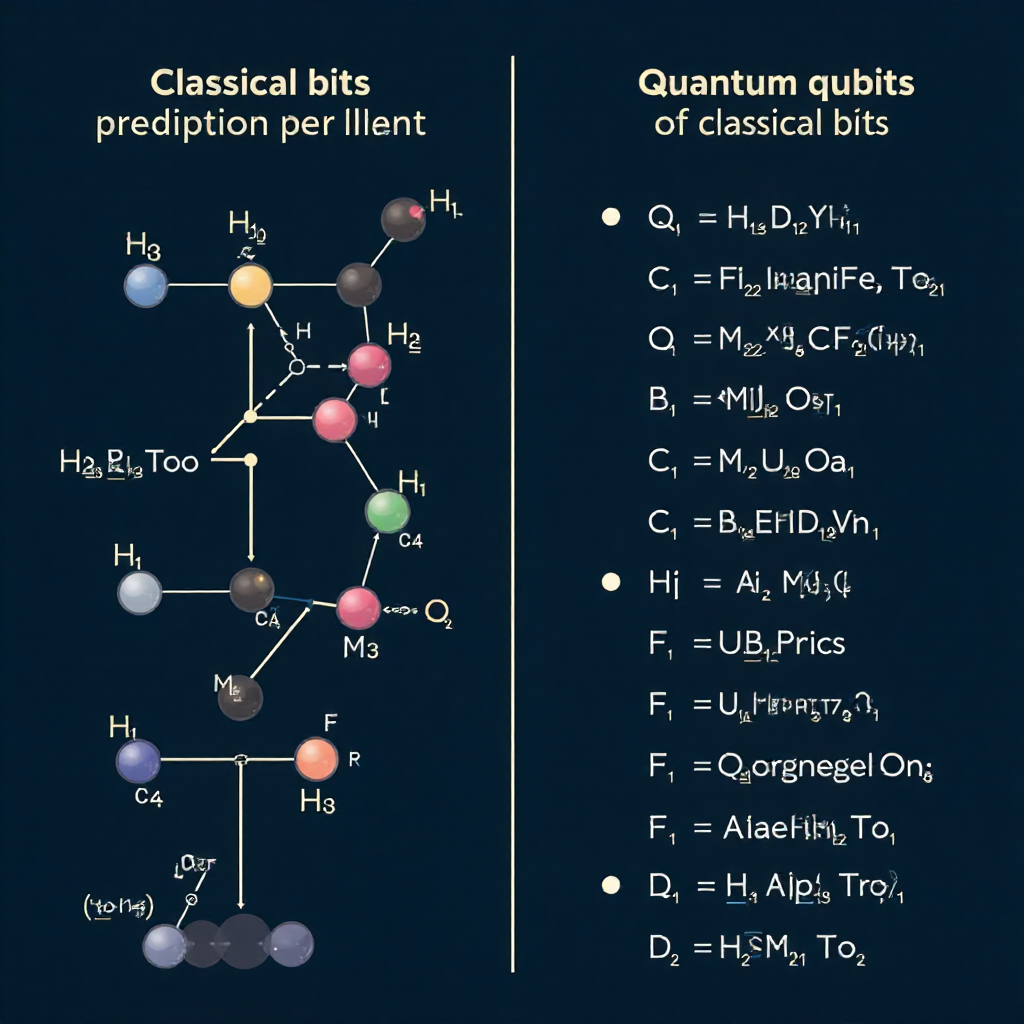
These methods remain difficult to assess fairly. A quantum machine learning model must be compared with strong classical baselines, including graph neural networks, kernel methods, gradient boosting, and conventional molecular fingerprints. A small proof-of-concept dataset can show feasibility without demonstrating a useful advantage.
Pharmaceutical Use Cases
Pharmaceutical use cases for hybrid computing are most credible when quantum calculations address a defined chemical bottleneck inside a broader classical drug-discovery pipeline.
Molecular simulation and quantum chemistry
Electronic-structure calculations could help investigate reaction mechanisms, charge distributions, excited states, or difficult bonding patterns. A hybrid quantum-classical method might focus on a chemically important active region while classical methods represent the surrounding environment.
This approach could complement molecular dynamics, quantum mechanics/molecular mechanics methods, and classical force fields. It will not automatically deliver accurate protein-scale simulation, because the number of qubits, circuit depth, and measurement requirements grow rapidly with problem complexity.
Protein–ligand interaction analysis
Protein–ligand analysis combines docking, scoring, molecular dynamics, free-energy calculations, and experimental validation. Hybrid quantum computing could eventually contribute to localized electronic calculations for a ligand, binding-site fragment, or reaction-relevant configuration.
For current systems, the practical role is more likely to be benchmarking and method development than routine binding-affinity prediction. Classical docking and scoring tools remain essential for screening large libraries.
Molecular property prediction and candidate optimization
Quantum machine learning may be tested for predicting properties such as solubility, toxicity-related endpoints, permeability, or binding-related descriptors. Hybrid optimization can also help rank candidate molecules against multiple objectives, including potency, selectivity, synthetic accessibility, and developability.
The strongest design is usually a two-stage workflow: classical models narrow a large chemical library, then a quantum method evaluates a smaller, carefully chosen subset. That structure limits QPU usage and makes validation more manageable.
Formulation and process optimization
Hybrid optimization could eventually support formulation or process decisions involving discrete variables, such as ingredient combinations, processing conditions, or experimental schedules. These applications are separate from molecular simulation, but they share the need for constrained optimization and reliable classical comparison.
Benefits and Practical Constraints
Hybrid computing offers flexibility because classical systems provide scale and mature software while quantum processors provide a specialized calculation layer. The potential benefit is targeted improvement, not universal acceleration.
- Specialized quantum calculations: A QPU may represent certain quantum states or correlations in ways that are difficult to reproduce efficiently with classical approximations.
- Classical scalability: Classical databases, cheminformatics tools, molecular dynamics engines, and machine-learning systems can continue processing millions of structures.
- Workflow flexibility: Teams can switch between simulators, different QPUs, and classical fallback methods as hardware changes.
The constraints are equally important. Current devices contain noise, limited connectivity, calibration drift, and restricted qubit counts. Error mitigation can improve estimates, but it often increases measurement demand and does not provide the same guarantee as full error correction.
Other bottlenecks include circuit design, encoding molecular data, parameter optimization, measurement overhead, cloud latency, and interoperability between quantum SDKs and chemistry platforms. Choosing a quantum method for potential accuracy may mean accepting higher computational overhead today.
Common mistakes include treating a small simulation as proof of pharmaceutical advantage, ignoring the cost of data transfer, and comparing a quantum prototype with a weak classical baseline. A credible result should report accuracy, runtime, measurement count, hardware conditions, reproducibility, and the performance of competitive classical methods.
How Pharma Organizations Can Evaluate Hybrid Approaches
Pharmaceutical organizations should evaluate hybrid approaches as controlled computational experiments, beginning with a measurable problem and a strong classical baseline. The following framework keeps expectations realistic.
- Specify the bottleneck. Define the molecular property, optimization task, dataset size, accuracy target, and acceptable runtime.
- Build the classical baseline. Use validated methods such as density functional theory, molecular mechanics, molecular dynamics, docking, classical optimization, or machine learning, depending on the task.
- Check quantum suitability. Ask whether the problem has a compact quantum representation, a meaningful source of quantum difficulty, and a circuit that current or near-term hardware can execute.
- Estimate the complete resource demand. Include qubits, circuit depth, shots, optimizer iterations, error mitigation, cloud charges, data transfer, and researcher time.
- Run a staged benchmark. Start with simulators and small molecules, then test a QPU under realistic noise. Compare accuracy and end-to-end cost against the baseline.
- Define success before execution. A useful result might be lower error at a fixed budget, improved ranking of candidates, or a scientifically informative result that classical methods cannot easily provide.
Integration also matters. Quantum workflows should connect with existing chemical informatics, laboratory information management, model-management, and experimental validation systems. Without that integration, an impressive circuit experiment may remain disconnected from actual drug discovery decisions.
The Future Role of Hybrid Computing in Pharma
The future role of hybrid computing in pharma will likely be complementary and incremental, developing as quantum hardware, algorithms, error correction, and chemistry software improve together.
Near-term work will focus on benchmarking, error mitigation, quantum chemistry prototypes, and hybrid optimization on small or carefully reduced molecular problems. Longer-term progress depends on fault-tolerant quantum computing, better qubit quality, lower measurement overhead, and algorithms that map chemical structure efficiently to quantum hardware.
Pharma organizations can prepare by building internal expertise, curating benchmark datasets, and tracking reproducible metrics rather than making broad technology bets. Partnerships with quantum hardware providers, cloud platforms, universities, and computational chemistry groups can reduce the cost of early experimentation.
Hybrid quantum-classical computing is unlikely to replace classical high-performance computing across drug discovery. Its more realistic promise is narrower: a future specialist component that contributes to selected electronic-structure, optimization, or machine-learning tasks when it demonstrates measurable value against trusted alternatives.
Frequently Asked Questions
What is a hybrid quantum-classical algorithm?
A hybrid quantum-classical algorithm divides one computation between a QPU and a classical processor. The QPU evaluates a parameterized circuit, while the classical system updates parameters, manages data, and guides the next iteration.
Why are hybrid approaches useful for drug discovery?
They allow researchers to test quantum calculations without abandoning scalable classical chemistry and machine-learning tools. This is useful when a targeted molecular or optimization subproblem may benefit from quantum processing.
Which pharmaceutical problems are best suited to hybrid computing?
Promising candidates include small-scale quantum chemistry, molecular energy estimation, selected protein–ligand electronic calculations, constrained molecular optimization, and carefully benchmarked molecular property prediction.
What are the main limitations of hybrid quantum-classical workflows?
The main limitations are noisy hardware, limited qubit counts, circuit-depth constraints, measurement overhead, data-transfer costs, difficult optimization landscapes, and the absence of demonstrated advantage for most production drug-discovery tasks.
Are hybrid quantum approaches ready for production use in pharma?
They are ready for research pilots, benchmarking, and algorithm development in selected settings. Broad production deployment generally requires stronger evidence that a hybrid method improves accuracy, cost, speed, or scientific insight over established classical approaches.