AI-Driven Drug Discovery Platforms: How Intelligent Systems Are Reshaping Pharmaceutical R&D
The Traditional Drug Discovery Problem — And Why It Demanded a Smarter Solution
Conventional drug development is extraordinarily expensive, slow, and prone to failure. From initial target identification to regulatory approval, the process typically spans 10 to 15 years and costs upwards of $2 billion per approved drug — with roughly 90% of candidates failing somewhere between preclinical testing and late-stage clinical trials.
The core problem isn't a lack of scientific knowledge. It's the sheer combinatorial scale of the challenge. The chemical space of drug-like molecules is estimated to contain more than 1060 compounds. Testing even a fraction of those through traditional high-throughput screening is physically and economically impossible. Researchers have historically relied on intuition, incremental analogue synthesis, and serendipity as much as systematic methodology.
Add to this the biological complexity of disease targets — proteins that fold unpredictably, pathways that vary between patients, off-target effects that only emerge in Phase III trials — and the case for a fundamentally different approach becomes hard to argue against. AI-driven platforms don't just speed up the old process. They change what's computationally tractable in the first place.
What AI-Driven Drug Discovery Platforms Actually Do
An AI-driven drug discovery platform is a software infrastructure that uses machine learning and computational modeling to automate and accelerate key stages of pharmaceutical R&D — from identifying disease-relevant biological targets to predicting which candidate molecules are worth synthesizing.
The functional scope varies by platform, but most address four core tasks:
- Target identification and validation: Mining genomic, proteomic, and clinical datasets to identify which proteins or pathways drive a disease — and whether modulating them is therapeutically viable.
- Virtual molecular screening: Evaluating millions of candidate compounds against a target in silico, filtering out poor binders before any wet-lab synthesis occurs.
- Lead optimization: Iteratively refining a promising molecule's structure to improve potency, selectivity, metabolic stability, and safety profile simultaneously.
- ADMET prediction: Forecasting absorption, distribution, metabolism, excretion, and toxicity properties early — reducing late-stage attrition caused by pharmacokinetic failures.
The practical value of compressing these steps computationally is significant. Decisions that once required months of bench work can be narrowed to days of simulation, allowing research teams to enter the preclinical stage with better-characterized candidates and a clearer rationale for each structural choice.
The Role of Machine Learning and Generative AI in Molecular Design
Machine learning algorithms give AI drug discovery platforms their predictive power, while generative AI models push the frontier further — from prediction into creation.
At the prediction layer, deep learning architectures — particularly graph neural networks — have proven effective at encoding molecular structure in ways that classical fingerprinting methods cannot. These models learn chemical relationships from large datasets of known compounds and their biological activities, then generalize to predict drug-target interaction affinities for molecules they've never seen. The result is a ranked shortlist of candidates with quantified confidence scores, not a blind guess.
Protein structure prediction represents one of the clearest recent breakthroughs in this space. The ability to computationally resolve how a protein folds — and therefore where a small molecule might bind — transformed structure-based drug design from a bottleneck into a scalable workflow. Researchers can now model target conformations that were previously inaccessible due to crystallography limitations.
Generative AI adds a different capability: designing molecules from scratch rather than selecting from a pre-existing library. Variational autoencoders and diffusion-based generative models can propose novel chemical structures optimized against multiple objectives simultaneously — binding affinity, synthetic accessibility, and off-target selectivity at once. This is a genuine departure from traditional computational chemistry, where optimization was largely sequential and human-directed.
That said, generative models are only as reliable as their training data. A model trained on well-characterized chemical series will extrapolate confidently within that space — and poorly outside it. This boundary matters enormously when researchers are targeting novel disease mechanisms with limited prior art.
Where Quantum Computing Enters the Picture
Quantum computing addresses a specific and fundamental limitation that classical AI alone cannot overcome: the accurate simulation of quantum mechanical interactions between molecules. This is where the two technologies become genuinely complementary rather than redundant.
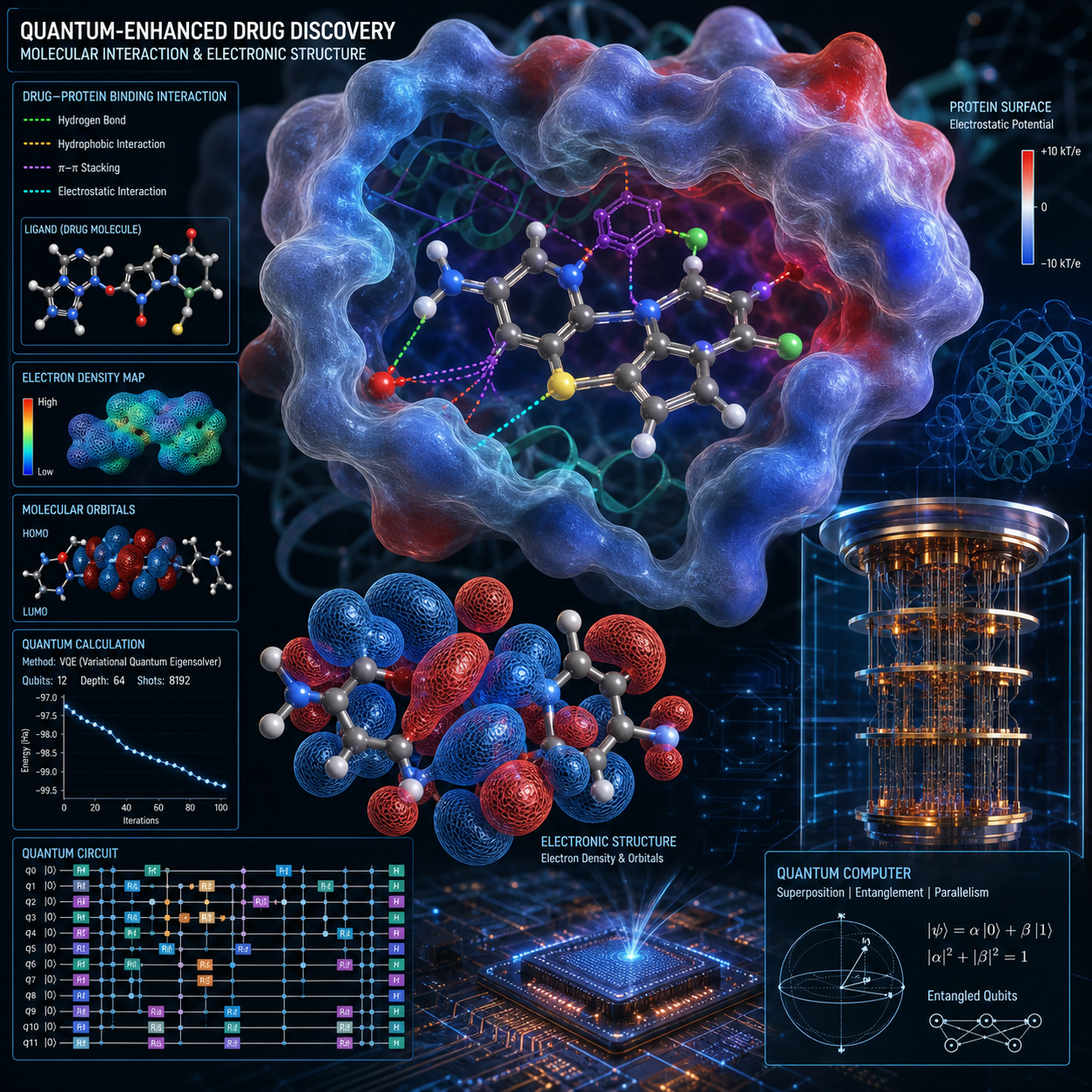
Molecular simulation at the electronic structure level — modeling how electrons distribute across atoms during binding — requires solving the Schrödinger equation for complex systems. Classical computers approximate this using methods like density functional theory (DFT), but the approximations become increasingly unreliable as molecular systems grow in size and complexity. Binding energy predictions for large, flexible drug-like molecules can carry errors large enough to reverse the ranking of candidates.
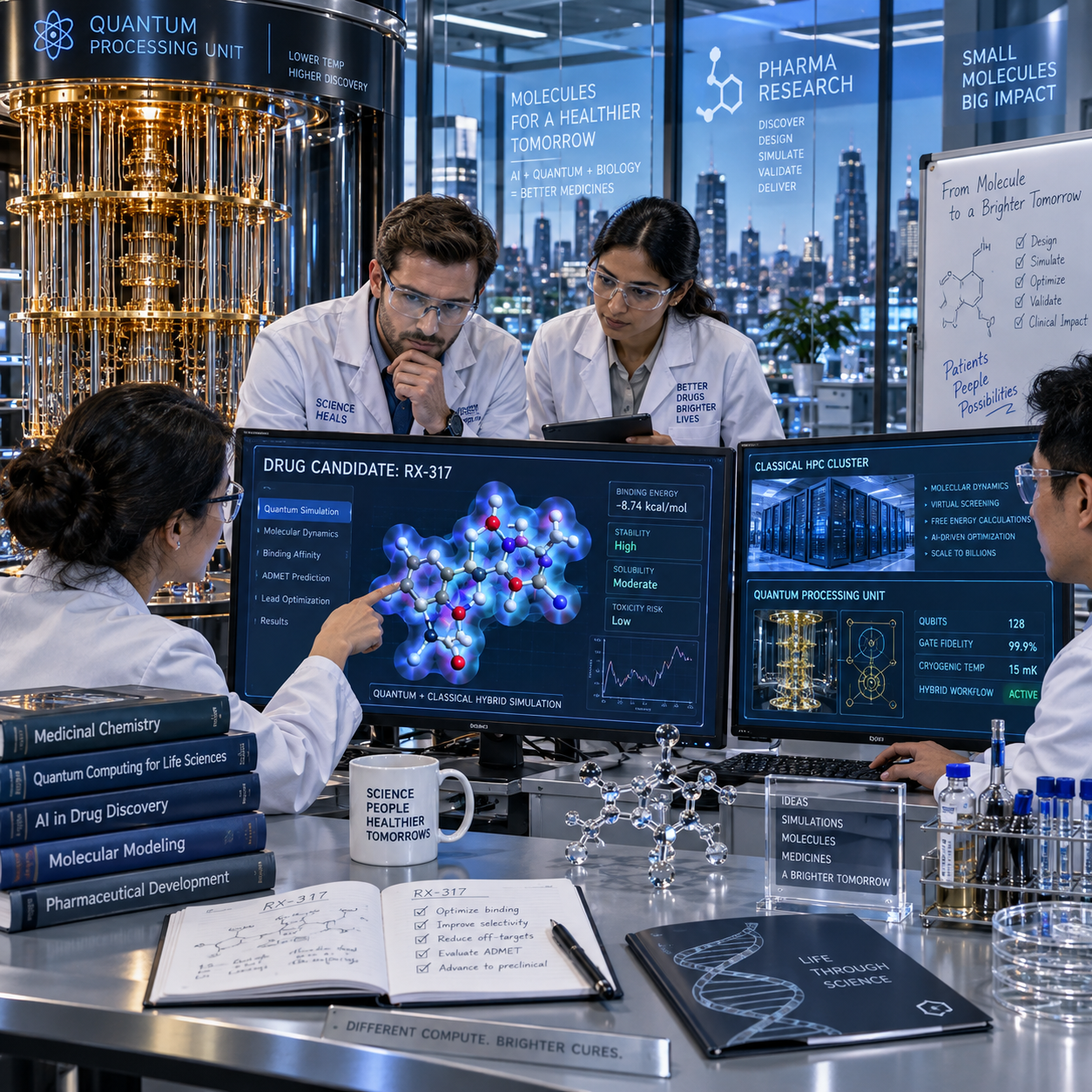
Quantum computers, by operating on qubits that exploit superposition and entanglement, can represent and manipulate quantum states directly. This makes them theoretically capable of simulating molecular interactions at a level of accuracy that would require impractical computational resources classically. For lead optimization scenarios where small energy differences between binding poses determine efficacy, that accuracy gap is clinically meaningful — not just academically interesting.
The current reality is that fault-tolerant quantum hardware capable of running full molecular simulations at pharmaceutical scale doesn't yet exist. What does exist — and is actively being integrated into hybrid workflows — is quantum-classical computing, where quantum processors handle specific high-complexity subroutines while classical AI manages the broader optimization loop. This hybrid architecture is where most near-term pharmaceutical quantum computing value will be extracted.
For drug discovery teams evaluating this landscape, the practical question isn't "quantum or AI?" but rather: which parts of our computational pipeline have accuracy bottlenecks that quantum acceleration could resolve?
Key Capabilities That Define a Robust AI Drug Discovery Platform
A genuinely capable AI drug discovery platform is defined by more than the sophistication of its models. Integration, interpretability, and pipeline compatibility matter just as much as raw predictive performance.
When evaluating platforms, technically literate teams should look for:
- Multi-modal data integration: The ability to ingest and cross-reference genomic, proteomic, structural, and clinical trial data — not just chemical libraries. Drug discovery is a multi-omics problem, and platforms that treat it as a pure cheminformatics exercise will hit ceiling effects quickly.
- Model interpretability: Predictions that can't be explained are difficult to act on and impossible to defend in regulatory submissions. Attention mechanisms, saliency maps, and uncertainty quantification are practical requirements, not optional features.
- Closed-loop experimental integration: The most effective platforms connect computational predictions to automated synthesis and assay workflows, creating a feedback loop where experimental results continuously retrain the models. This is what separates a prediction tool from a discovery engine.
- Simulation fidelity controls: Honest confidence intervals on binding affinity predictions, explicit acknowledgment of applicability domain limits, and flagging of structurally novel molecules where model reliability degrades.
Platforms that score well on all four dimensions are rare. Most excel in one or two areas and require integration with external tools for the rest — which is a legitimate architectural choice, but one that should be made deliberately rather than discovered mid-project.
Current Challenges and Honest Limitations
AI drug discovery platforms are genuinely powerful — and genuinely limited in ways that matter for anyone making research or investment decisions based on their outputs.
The most persistent challenge is data quality. Machine learning algorithms are pattern-matching systems. When the underlying biological assay data is noisy, inconsistently measured, or biased toward historically druggable target classes, the models inherit those biases silently. A model trained predominantly on kinase inhibitor data will not generalize reliably to protein-protein interaction disruptors — a category that represents some of the most therapeutically important but structurally challenging targets in oncology and neurodegeneration.
The gap between in-silico predictions and wet-lab outcomes remains substantial. Predicted binding affinities frequently diverge from measured values by factors that change candidate rankings. Predicted ADMET properties are better than random, but not reliable enough to eliminate experimental confirmation. The clinical trial pipeline still requires biological validation at every stage — AI compresses the search space, but it doesn't replace the experiment.
There's also a subtler problem with generative models: optimizing a molecule against a computational objective function doesn't guarantee the result is synthesizable, stable, or biologically meaningful outside the simulation. Researchers have learned to build synthetic accessibility scores and drug-likeness filters into generative pipelines, but these are heuristics, not guarantees.
None of this undermines the value of AI-driven platforms. It does mean that teams who treat model outputs as hypotheses to be tested — rather than answers to be acted on directly — will get more durable results than those who don't.
The Road Ahead — Convergence of AI, Quantum Computing, and Pharma Innovation
The next decade of drug discovery will likely be defined by the progressive convergence of AI-driven platforms with quantum computing hardware, creating a combined capability that neither technology delivers alone.
On the AI side, the trajectory points toward increasingly multimodal foundation models trained on unified biological datasets — integrating protein sequences, 3D structures, clinical outcomes, and patient genomics into a single representational framework. This would allow platforms to reason across scales, from molecular binding events to population-level treatment response, in a way current task-specific models cannot.
On the quantum side, as error-corrected qubit counts scale, the accuracy ceiling on molecular modeling will rise. The most immediate pharmaceutical applications will likely be in binding free energy calculations for difficult targets — cases where classical approximations currently produce rankings that don't survive experimental validation. Quantum-enhanced simulations in these specific bottlenecks could meaningfully improve the preclinical-to-clinical translation rate.
The broader shift is organizational as much as technical. Pharmaceutical companies that build internal competency in AI-driven workflows — not just licensing platforms, but understanding how to curate data, validate model outputs, and design hybrid computational-experimental loops — will compound advantages over time. The tools are becoming more powerful. The limiting factor is increasingly the quality of scientific judgment applied to their outputs.
Drug discovery won't be automated. But the frontier of what's computationally tractable is expanding rapidly, and the combination of AI and quantum computing is the most credible mechanism by which that frontier will continue to move.
Frequently Asked Questions
What is an AI-driven drug discovery platform and how does it differ from traditional computational tools?
An AI-driven drug discovery platform uses machine learning algorithms to learn patterns from biological and chemical data, enabling predictions that improve with more data. Traditional computational tools like docking software apply fixed physical models and don't adapt based on experimental feedback. The key difference is that AI platforms generalize across chemical space rather than evaluating each compound independently against a static scoring function.
How does quantum computing improve AI-based molecular simulations?
Quantum computing improves molecular simulation accuracy by representing quantum mechanical interactions directly, rather than approximating them classically. For drug discovery, this matters most in binding energy calculations where classical approximations introduce errors large enough to misrank candidates. Hybrid quantum-classical workflows use quantum processors for the highest-complexity subroutines while AI manages the broader search and optimization process.
Can AI platforms fully replace wet-lab experimentation in drug discovery?
No. AI platforms compress and prioritize the experimental search space — they don't eliminate the need for biological validation. Predicted binding affinities, ADMET properties, and selectivity profiles all require experimental confirmation before candidates advance through the clinical trial pipeline. The value is in reducing the number of experiments needed, not removing them.
What types of diseases or drug classes benefit most from AI-driven discovery approaches?
Diseases with large genomic and proteomic datasets — oncology, rare genetic disorders, and certain infectious diseases — have seen the most early traction. Small molecule drug classes benefit from well-established training data. Biologics and protein-protein interaction targets are harder, partly due to data scarcity and partly because the computational chemistry is more demanding. These are active areas of platform development rather than solved problems.
What are the biggest barriers to adopting AI platforms in pharmaceutical companies today?
Data quality and internal data infrastructure are the most common practical barriers. AI models require large, consistently formatted, and well-annotated biological datasets — and most pharmaceutical companies have data distributed across legacy systems in incompatible formats. Beyond data, there's a skills gap: effectively using AI drug discovery platforms requires computational scientists who understand both the biology and the model limitations, a combination that remains scarce.