
Quantum Algorithms for Molecular Simulations: Transforming Drug Discovery
Drug discovery has always been a numbers game — and the numbers are brutal. Bringing a single drug to market takes an average of 10–15 years and over $2 billion, with failure rates exceeding 90% in clinical trials. A significant share of those failures trace back to one root cause: we don't understand molecular behavior well enough at the quantum mechanical level. That gap is exactly where quantum algorithms for molecular simulations are beginning to change the equation.
Why Classical Molecular Simulation Falls Short in Drug Discovery
Classical computers struggle with molecular simulation because electrons don't follow classical rules — they follow quantum mechanics. To accurately model even a moderately complex molecule, a classical system must track an exponentially growing number of quantum states, which quickly becomes computationally intractable.
Consider caffeine. It has 24 atoms. A full quantum mechanical description of its electron interactions requires representing a state space with roughly 1048 parameters — far beyond what any classical supercomputer can handle directly. Pharmaceutical molecules of interest are far larger.
Current workhorse methods like Density Functional Theory (DFT) and molecular dynamics simulation sidestep this by using approximations. DFT, for instance, replaces the full many-electron wavefunction with electron density functions, dramatically reducing computational cost. But those approximations introduce errors — and in drug discovery, those errors compound. A 1 kcal/mol error in binding energy prediction can shift a drug candidate's ranking entirely, sending researchers down the wrong path for years.
The computational bottleneck isn't just a speed problem. It's a fidelity problem. Classical methods trade accuracy for feasibility, and pharmaceutical R&D pays the price downstream.
How Quantum Computing Approaches Molecular Simulation Differently
Quantum computers are naturally suited to molecular simulation because molecules are themselves quantum systems. A quantum processor doesn't approximate quantum behavior — it enacts it directly through qubits, superposition, and entanglement.
A classical bit is either 0 or 1. A qubit can exist in a superposition of both simultaneously. When multiple qubits are entangled, their states become correlated in ways that allow a quantum processor to represent exponentially large solution spaces with a polynomial number of physical components. For molecular simulation, this means encoding electron configurations and their interactions directly into the quantum hardware rather than approximating them.
The practical implication: a quantum computer with 50–100 logical qubits could, in principle, simulate molecular systems that would require classical resources beyond anything physically realizable. The key word is logical — accounting for error correction, which remains an active challenge. But the architectural fit between quantum hardware and quantum chemistry problems is not a coincidence. It's the core reason the pharmaceutical industry is paying attention.

Key Quantum Algorithms Used in Molecular Simulations
Two algorithms dominate the conversation in quantum chemistry today: the Variational Quantum Eigensolver (VQE) and Quantum Phase Estimation (QPE). They approach the same core problem — finding the ground-state energy of a molecular system — through different mechanisms, each with distinct trade-offs.
Variational Quantum Eigensolver (VQE)
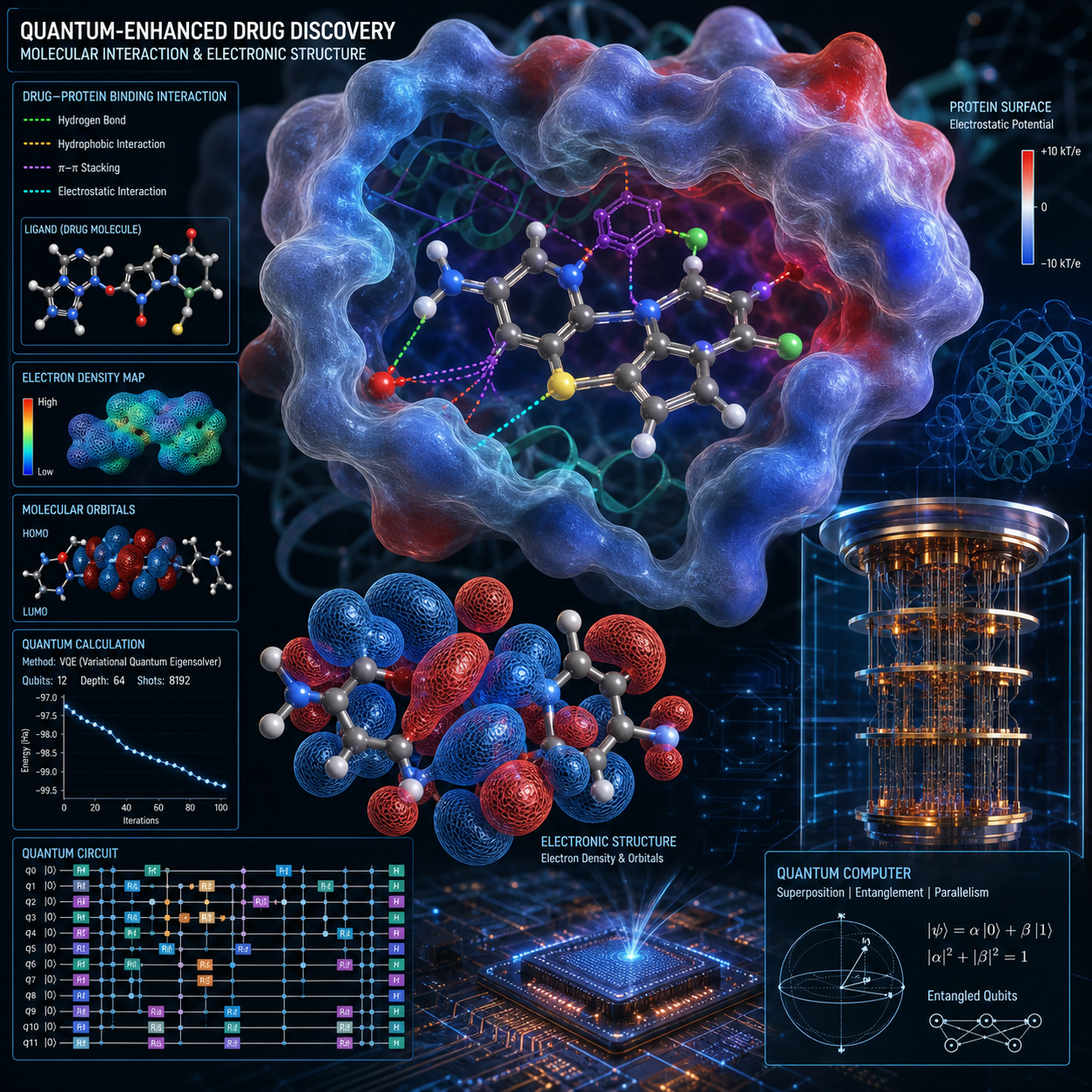
VQE is a hybrid quantum-classical algorithm designed to run on today's noisy hardware. It works by preparing a parameterized quantum state (called an ansatz) on the quantum processor, measuring its energy, then using a classical optimizer to adjust the parameters iteratively until the lowest energy state is found.
The appeal of VQE is pragmatism. It's designed for NISQ devices — systems with limited qubit counts and significant noise — making it the most experimentally accessible algorithm for near-term molecular simulation. Researchers have used VQE to calculate ground-state energies for small molecules like H₂, LiH, and BeH₂ on real quantum hardware. The results aren't yet competitive with the best classical methods for large molecules, but the trajectory is encouraging.
Quantum Phase Estimation (QPE)
QPE is the more powerful, longer-horizon algorithm. It can extract molecular energies with exponentially better precision than VQE, but it requires fault-tolerant quantum hardware with thousands of logical qubits and deep circuit execution — capabilities that don't exist yet at scale.
For pharmaceutical applications, QPE's promise is significant: it could eventually compute electronic structure calculations for drug-sized molecules with chemical accuracy (errors below 1 kcal/mol) without the approximations that plague DFT. That level of precision could transform how researchers predict binding affinities and reaction pathways.
Other relevant methods include the Quantum Approximate Optimization Algorithm (QAOA) for conformational search problems, and quantum machine learning approaches being explored for property prediction. But VQE and QPE remain the primary algorithmic pillars of quantum chemistry.
Simulating Protein-Ligand Interactions and Electronic Structures
The most commercially relevant application of quantum molecular simulation in pharma is protein-ligand binding prediction. When a drug candidate binds to its target protein, the strength and geometry of that interaction determines efficacy. Getting this wrong is one of the leading causes of late-stage trial failures.
Classical docking algorithms estimate binding affinity using force fields — simplified mathematical models of atomic interactions. They're fast but imprecise, particularly for systems involving metal cofactors, charge transfer, or polarization effects that require quantum mechanical treatment.
Quantum algorithms can, in principle, model the electronic structure of the binding pocket directly — capturing the subtle quantum effects that classical force fields miss. For metalloenzymes (enzymes with metal ion active sites, common drug targets in oncology and infectious disease), this distinction matters enormously. The electronic configuration of the metal center governs reactivity in ways that DFT approximations frequently misrepresent.
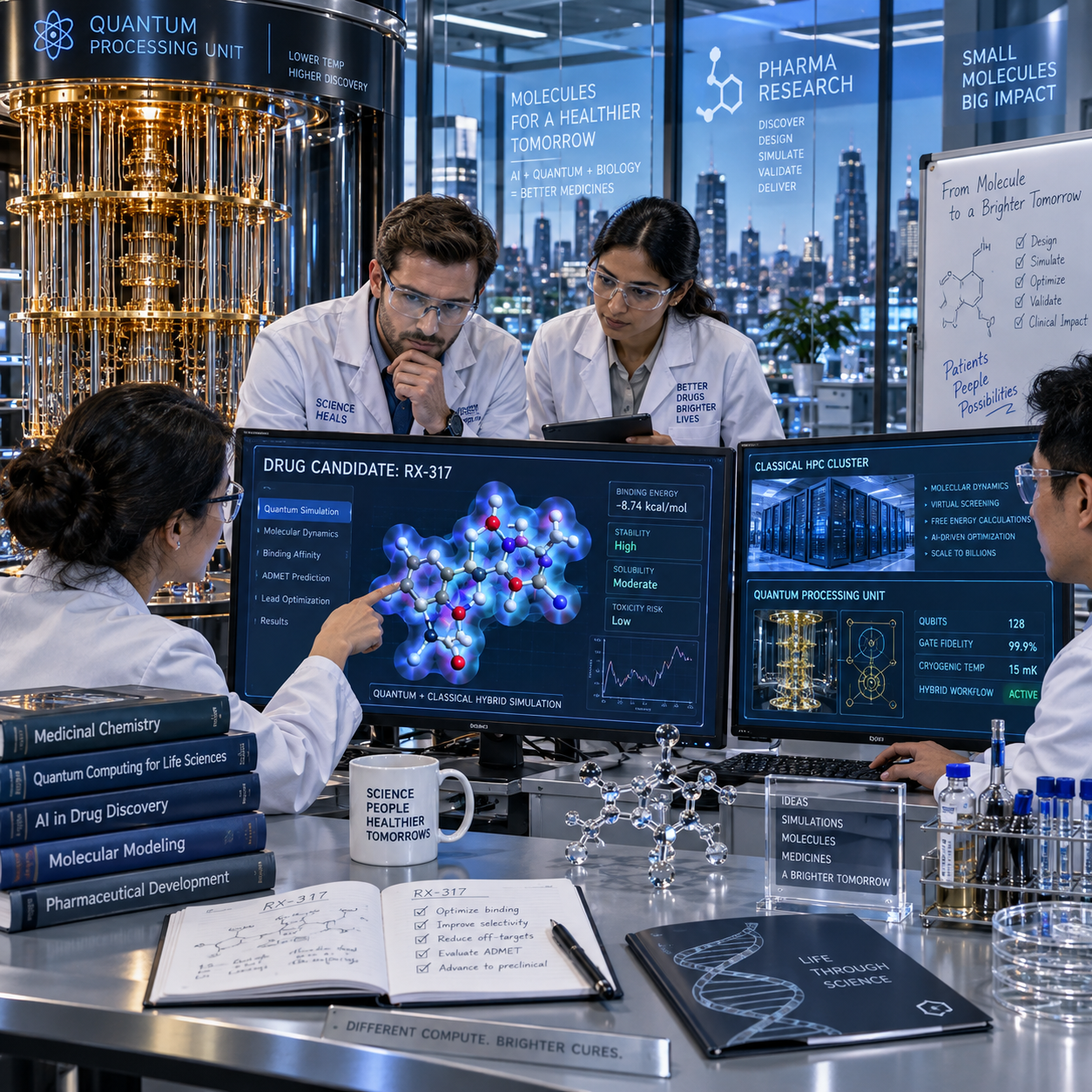
A realistic near-term workflow might look like this: use classical molecular dynamics simulation to explore conformational space broadly, then apply VQE-based electronic structure calculations to the top candidate binding poses for higher-fidelity energy ranking. This hybrid approach — classical for sampling, quantum for accuracy — is already being prototyped by several research groups.
Current Limitations — NISQ Devices and Practical Barriers
Quantum molecular simulation is genuinely promising, but today's hardware is not yet ready for production pharmaceutical workflows. Honest assessment matters here.
NISQ devices — the noisy intermediate-scale quantum processors available today from IBM, Google, IonQ, and others — have two fundamental problems: limited qubit counts (typically 50–1000 physical qubits) and high error rates. Quantum gates introduce errors that accumulate as circuit depth increases. For VQE to simulate a molecule like aspirin accurately would require circuit depths that exceed what current hardware can execute reliably.
Error correction can fix this, but at a steep cost. Encoding one logical qubit (error-corrected) requires hundreds to thousands of physical qubits depending on the error correction code used. A fault-tolerant quantum computer capable of running QPE on drug-relevant molecules likely requires millions of physical qubits — a hardware scale that is years away.
There's also the problem of qubit connectivity and coherence time. Molecular simulation algorithms require specific qubit interaction patterns that don't always match the hardware topology, introducing additional overhead. Coherence time — how long qubits maintain their quantum state — limits how complex a calculation can be before noise dominates.
None of this invalidates the long-term potential. It does mean that claims of quantum advantage for real drug discovery workflows should be scrutinized carefully today.
The Road Ahead — Quantum Molecular Simulation in the Pharmaceutical Pipeline
The next five to ten years will likely see quantum molecular simulation move from proof-of-concept demonstrations to genuine utility for specific, well-defined problems in pharmaceutical research.
Near-term milestones worth watching include: VQE demonstrations on molecules with 20+ heavy atoms on improved NISQ hardware, early fault-tolerant devices running small QPE calculations, and better quantum-classical hybrid workflows that extract value from limited quantum resources. Several pharmaceutical companies — including major players in oncology and infectious disease — have already established quantum computing partnerships with hardware vendors and algorithm developers to position themselves for this transition.
The most likely first real-world applications will be narrow but high-value: accurate electronic structure calculations for specific metalloenzyme active sites, improved binding energy rankings for a shortlist of drug candidates, or quantum-accelerated conformational sampling for flexible protein targets. These aren't breakthroughs in isolation — they're incremental improvements to existing workflows that compound into better decisions earlier in the pipeline.
Regulatory bodies like the FDA are also beginning to engage with computational chemistry validation frameworks. As quantum methods mature, establishing validation standards for quantum-derived molecular data will become a practical necessity for pharmaceutical submissions. Researchers interested in the broader computational chemistry landscape can explore resources from the National Institute of Standards and Technology's quantum information science program for foundational context.
What Pharmaceutical Researchers Should Know Now
Quantum computing is not yet a tool you deploy in your lab. But it's close enough to the horizon that R&D strategy decisions made today will determine who is positioned to benefit first.
Here are four concrete steps for pharmaceutical scientists and R&D decision-makers:
- Map your computational bottlenecks. Identify where your current molecular simulation workflows lose accuracy due to approximations — particularly for metal-containing targets, charge-transfer systems, or molecules where DFT repeatedly underperforms. These are your highest-priority use cases for quantum methods.
- Invest in quantum literacy, not quantum hardware. You don't need to buy a quantum computer. You need team members who understand VQE, QPE, and quantum chemistry well enough to evaluate vendor claims, read the literature critically, and design quantum-ready workflows.
- Engage with cloud-based quantum platforms. IBM Quantum, Amazon Braket, and Azure Quantum all offer access to real quantum hardware and simulators. Running small-scale quantum chemistry experiments on these platforms builds institutional knowledge at low cost.
- Follow the fault-tolerance roadmap. The transition from NISQ to early fault-tolerant devices is the inflection point for pharmaceutical relevance. Hardware vendors publish roadmaps; tracking them helps you anticipate when quantum methods will become practically competitive for your specific problem classes.
The researchers who will benefit most from quantum molecular simulation are those who start building fluency now — not waiting for a finished product, but engaging with the technology as it develops.

Frequently Asked Questions
What is the difference between VQE and Quantum Phase Estimation for molecular simulation?
VQE is a hybrid quantum-classical algorithm designed for current NISQ hardware. It uses shorter quantum circuits and iterative classical optimization, making it practical today but less precise. QPE is a fully quantum algorithm capable of much higher accuracy, but it requires fault-tolerant hardware with deep circuits — technology that isn't yet available at useful scale. VQE is the near-term workhorse; QPE is the long-term target.
Can quantum algorithms replace classical molecular dynamics tools today?
No. Classical molecular dynamics simulation tools remain essential and will continue to be for the foreseeable future. Quantum algorithms currently complement classical methods rather than replace them — handling specific high-accuracy calculations where quantum mechanical effects dominate, while classical tools handle large-scale conformational sampling and system-level dynamics.
How many qubits are needed to simulate a drug-relevant molecule accurately?
Estimates vary by molecule and required accuracy, but simulating a medium-sized drug molecule (30–50 heavy atoms) with chemical accuracy using QPE is projected to require thousands of logical qubits — which translates to millions of physical qubits with current error correction overhead. Today's hardware is far short of this. Small proof-of-concept molecules can be studied now, but clinically relevant molecules remain out of reach for the near term.
What types of drugs or diseases stand to benefit most from quantum molecular simulation?
Diseases where drug targets involve complex quantum mechanical behavior are the most promising candidates. This includes metalloenzyme targets relevant to cancer, antibiotic resistance, and neurodegenerative diseases, as well as protein-ligand systems where charge transfer and polarization effects are critical. Oncology and infectious disease research are frequently cited as early beneficiaries.
How does quantum molecular simulation integrate with existing computational chemistry workflows?
The most practical integration model is hybrid: classical methods handle large-scale screening and conformational sampling, then quantum algorithms are applied to a smaller set of high-priority candidates for more accurate energy calculations. Existing quantum chemistry software frameworks like PySCF and OpenFermion already include interfaces for quantum hardware, allowing researchers to begin building quantum-aware workflows within familiar computational environments.